What Percentage of Black Families Have No Father

The family unit structure of African Americans has long been a thing of national public policy involvement.[2] A 1965 written report by Daniel Patrick Moynihan, known every bit The Moynihan Written report, examined the link betwixt blackness poverty and family construction.[2] It hypothesized that the destruction of the black nuclear family unit construction would hinder farther progress toward economic and political equality.[2]
When Moynihan wrote in 1965 on the coming destruction of the black family, the out-of-wedlock birth rate was 25% among black people.[3] In 1991, 68% of black children were born exterior of wedlock (where 'marriage' is divers with a government-issued license).[four] In 2011, 72% of black babies were born to unmarried mothers,[5] [6] while the 2018 National Vital Statistics Report provides a figure of 69.iv percent for this condition.[vii]
Among all newlyweds, xviii.0% of blackness Americans in 2015 married not-black spouses.[viii] 24% of all black male newlyweds in 2015 married outside their race, compared with 12% of blackness female newlyweds.[8] v.five% of black males married white women in 1990.[9]
History [edit]
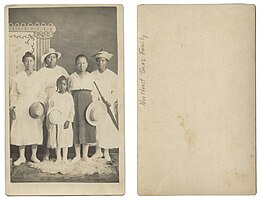
An African American family, photographed between 1918-22. Courtesy of the DeGolyer Library, Southern Methodist University.
According to data extracted from 1910 U.S. Census manuscripts, compared to white women, blackness women were more likely to become teenage mothers, stay unmarried and take union instability, and were thus much more probable to alive in female-headed unmarried-parent homes.[ten] [11] This pattern has been known as black matriarchy considering of the observance of many households headed by women.[11]
The breakup of the blackness family was showtime brought to national attending in 1965 by sociologist and later Democratic Senator Daniel Patrick Moynihan, in the groundbreaking Moynihan Report (also known as "The Negro Family: The Instance For National Action").[12] Moynihan'southward report fabricated the argument that the relative absence of nuclear families (those having both a married male parent and mother present) in blackness America would greatly hinder further blackness socio-economic progress.[12]
The electric current about widespread African-American family structure consisting of a single parent has historical roots dating back to 1880.[13] A report of 1880 family structures in Philadelphia, showed that three-quarters of black families were nuclear families, equanimous of two parents and children.[14] Data from U.S. Census reports reveal that betwixt 1880 and 1960, married households consisting of two-parent homes were the virtually widespread form of African-American family structures.[13] Although the virtually popular, married households decreased over this time menses. Single-parent homes, on the other hand, remained relatively stable until 1960; when they rose dramatically.[xiii]
In the Harlem neighborhood of New York City in 1925, 85 percent of kin-related black households had two parents.[xv] When Moynihan warned in his 1965 written report on the coming destruction of the black family, however, the out-of-marriage birthrate had increased to 25% among the black population.[12] This effigy connected to ascent over fourth dimension and in 1991, 68% of black children were born outside of marriage.[16] U.Southward. Census information from 2010 reveal that more African-American families consisted of single mothers than married households with both parents.[17] In 2011, it was reported that 72% of black babies were built-in to unmarried mothers.[11] Equally of 2015, at 77.3 percentage, black Americans have the highest charge per unit of non-marital births among native Americans.[18]
In 2016 29% of African Americans were married, while 48% of all Americans were. Also, 50% of African Americans have never been married in dissimilarity to 33% of all Americans. In 2016 just under half (48%) of black women had never been married which is an increase from 44% in 2008 and 42.7% in 2005. 52% of black men had never been married. As well, 15% percent of black men were married to non-blackness women which is up from 11% in 2010. Black women were the least likely to ally not-black men at only seven% in 2017.[nineteen]
The African-American family construction has been divided into a twelve-office typology that is used to show the differences in the family structure based on "gender, marital status, and the presence or absence of children, other relatives or non-relatives."[20] These family sub-structures are divided up into three major structures: nuclear families, extended families, and augmented families.
African-American families at a glance [edit]
African-American nuclear families [edit]
Andrew Billingsley'southward inquiry on the African-American nuclear family unit is organized into four groups: Incipient Nuclear, Simple Nuclear, Segmented Nuclear I, and Segmented Nuclear II.[twenty] In 1992 Paul Glick supplied statistics showing the African-American nuclear family structure consisted of eighty% of full African-American families in comparison to 90% of all Usa families.[21] According to Billingsley, the African-American incipient nuclear family unit structure is defined as a married couple with no children.[twenty]
In 1992 47% of African-American families had an incipient nuclear family in comparing to 54% of all Us incipient nuclear families.[22] The African-American simple nuclear family structure has been defined equally a married couple with children.[20] This is the traditional norm for the composition of African-American families.[23] In 1992 25% of African-American families were uncomplicated nuclear families in comparison to 36% of all US families.[22] About 67 percent of black children are born into a unmarried parent household.[24]
The African-American segmented nuclear I (unmarried mother and children) and II (single father and children) family unit structures are defined equally a parent–child human relationship.[xx] In 1992, 94% of African-American segmented nuclear families were composed of an unmarried female parent and children.[22] Glick's inquiry found that single parent families are twice every bit prevalent in African-American families as they are in other races, and this gap continues to widen.[21]
African-American extended families [edit]
Billingsley'south research continued with the African-American extended family structure, which is equanimous of chief members plus other relatives.[20] Extended families have the aforementioned sub-structures as nuclear families, incipient, simple, segmented I, and segmented Two, with the addition of grandparents, aunts, uncles, cousins and boosted family unit members. Billingsley'south research institute that the extended family unit structure is predominantly in the segmented I sub-structured families.[20]
In 1992 47% of all African-American extended families were segmented extended family unit structures, compared to 12% of all other races combined.[25] Billingsley's research shows that in the African-American family the extended relative is often the grandparents.[26]
African-American augmented families [edit]
Billingsley's research revealed another type of African-American family, called the augmented family structure, which is a family unit equanimous of the primary members, plus nonrelatives.[20] Billingsley's case study found that this family structure accounted for 8% of black families in 1990.[27] This family construction is different from the traditional norm family discussed earlier, it combines the nuclear and extended family units with nonrelatives. This structure also has the incipient, simple, segmented I, and segmented Two sub-structures.[20]
Non-family households [edit]
Billingsley introduced a new family structure that branches from the augmented family unit structure.[27] The African-American population is starting to see a new construction known as a not-family household. This not-family household contains no relatives.[28] According to Glick in 1992, 37% of all households in the The states were a nonfamily household, with more than half of this percent being African-Americans.[29]
African-American interracial marriages [edit]
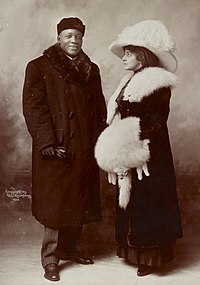
Among all newlyweds, 18.0% of Blackness Americans in 2015 married someone whose race or ethnicity was different from their ain.[8] 24% of all Black male person newlyweds in 2015 married outside their race, compared with 12% of Blackness female person newlyweds.[eight]
In the United States there has been a historical disparity between Black female and Dorsum male exogamy ratios. There were 354,000 White female/Blackness male person and 196,000 Black female person/White male marriages in March 2009, representing a ratio of 181:100.[30]
This traditional disparity has seen a rapid pass up over the concluding two decades, contrasted with its height in 1981 when the ratio was still 371:100.[31] In 2007, four.6% of all married Black people in the United States were wed to a White partner, and 0.iv% of all Whites were married to a Black partner.[32]
The overall rate of African-Americans marrying non-Black spouses has more than tripled between 1980 and 2015, from 5% to 18%.[8]
African-American family members at a glance [edit]
E. Franklin Frazier has described the current African-American family structure as having two models, one in which the male parent is viewed equally a patriarch and the sole breadwinner, and 1 where the mother takes on a matriarchal function in the identify of a fragmented household.[33] In defining family, James Stewart describes it as "an institution that interacts with other institutions forming a social network."[23]
Stewart's research concludes that the African-American family unit has traditionally used this definition to structure institutions that upholds values tied to other black institutions resulting in unique societal standards that deal with "economics, politics, education, health, welfare, constabulary, civilization, religion, and the media."[34] Ruggles argues that the modern black U.S. family has seen a change in this tradition and is at present viewed as predominantly single parent, specifically black matriarchy.[13]
Male parent representative [edit]
In 1997, McAdoo stated that African-American families are "frequently regarded every bit poor, fatherless, dependent of governmental assistance, and involved in producing a multitude of children outside of wedlock."[35] Thomas, Krampe and Newton show that in 2005 39% of African-American children did non live with their biological father and 28% of African-American children did not live with whatever father representative, compared to xv% of white children who were without a father representative.[36] In the African-American culture, the male parent representative has historically acted as a part model for two out of every three African-American children.[37]
Thomas, Krampe, and Newton relies on a 2002 survey that shows how the father's lack of presence has resulted in several negative effects on children ranging from education performance to teen pregnancy.[38] Whereas the father presence tends to take an opposite effect on children, increasing their chances on having a greater life satisfaction. Thomas, Krampe, and Newton'south research shows that 32% of African-American fathers rarely to never visit their children, compared to 11% of white fathers.[36]
In 2001, Hamer showed that many[ vague ] African-American youth did non know how to approach their father when in his presence.[39] This survey also ended that the not resident fathers who did visit their child said that their office consisted of primarily spending time with their children, providing discipline and being a role model.[40] John McAdoo also noted that the residential male parent role consists of existence the provider and decision maker for the household.[41] This concept of the father's role resembles the theory of hegemonic masculinity. Quaylan Allan suggests that the continuous comparing of white hegemonic masculinity to black manhood, can also add together a negative consequence on the presence of the father in the African-American family structure[42]
Female parent representative [edit]
Melvin Wilson suggests that in the African-American family structure a female parent'due south office is adamant by her relationship condition, is she a single female parent or a married mother?[43] Co-ordinate to Wilson, in near African-American married families a mother's roles is dominated by her household responsibilities.[44] Wilson research states that African American married families, in contrast to White families, do not have gender specific roles for household services.[45] The mother and wife is responsible for all household services effectually the house.[44]
According to Wilson, the married mother'southward tasks around the business firm is described every bit a full-time job. This full-time job of household responsibilities is often the second job that an African-American adult female takes on.[45] The first job is her regular eight hour work twenty-four hours that she spends outside of the home. Wilson too notes that this responsibility that the mother has in the married family determines the life satisfaction of the family unit as a whole.[45]
Melvin Wilson states that the single female parent role in the African-American family is played by 94% of African-American single parents.[46] According to Dark-brown, single parent maternity in the African-American civilisation is becoming more a "proactive" choice.[47] Melvin Wilson's inquiry shows 62% of single African-American women said this selection is in response to divorce, adoption, or just non union compared to 33% of unmarried white women.[48] In this position African-American single mothers see themselves playing the role of the mother and the father.[47]
Though the role of a single mother is similar to the function of a married mother, to have care of household responsibilities and work a full-time task, the single mothers' responsibility is greater since she does not take a second party income that a partner would provide for her family members. According to Brown, this lack of a 2nd party income has resulted in the majority of African American children raised in single mother households having a poor upbringing.[49]
Child [edit]
In Margaret Spencer's example written report on children living in southern metropolitan areas, she shows that children can only grow through enculturation of a detail gild.[50] The child'south development is dependent on iii areas: kid-rearing practices, individual heredity, and experienced cultural patterns. Spencer's enquiry also concludes that African-American children take become subject to inconsistencies in society based on their skin color.[51] These inconsistencies continue to place an increased amount of environmental stress on African-American families which result in the failure of most African-American children to reach their full potential.[52]
Similar to most races, challenges that African-American families experience are ordinarily dependent on the children's historic period groups.[53] The African-American families experience a nifty deal of mortality within the babe and toddler age group. In particular the infant mortality rate is "twice as loftier for blackness children equally for children in the nation equally a whole."[53] The mortality in this historic period group is accompanied by a pregnant number of illnesses in the pre- and postal service-natal care stages, along with the failure to identify these children into a positive, progressive learning surroundings once they go toddlers.[54] This foundation has led to African-American children facing teen pregnancy, juvenile detention, and other behavioral problems because they were non given the proper evolution to successfully face the world and social inconsistencies they will meet.[54]
Extended family members [edit]
Jones, Zalot, Foster, Sterrett, and Chester executed a written report examining the childrearing aid given to young adults and African-American single mothers.[55] The majority of extended family members, including aunts, uncles, cousins, grandparents, and occasionally non-relatives, are put into this category.[55] : 673 In Jones research she also notes that 97% of single female parent's ages 28–twoscore admitted that they rely on at least one extended family unit member for assistance in raising their children.[55] : 676
Extended family unit members have an immense amount of responsibility in the majority of African-American families, particularly single parent households. According to Jones, the reason these extended family members are included in having a necessary role in the family is considering they play a central role in assuring the health and well-being of the children.[55] : 673 The extended family members' responsibilities range from child rearing, fiscal assistance, offering a identify to live, and meals.[55] : 674
Theories [edit]
Economic theories [edit]
In that location are several hypotheses – both social and economic – explaining the persistence of the electric current African-American family structure. Some researchers theorize that the depression economic statuses of the newly freed slaves in 1850 led to the current family structure for African Americans. These researchers suggest that extreme poverty has increased the destabilization of African American families while others point to high female labor participation, few task opportunities for black males, and pocket-sized differences between wages for men and women that accept decreased marriage stability for black families.[xiii]
Some other economic theory dates back to the late 1950s and early '60s, the creation of the "Man-in-the-House" rule; this restricted 2 parent households from receiving government benefits which made many black fathers move out to be able to receive assist to support their families. These rules were later on abolished when the Supreme Courtroom ruled confronting these exclusions in the instance of King vs Smith.[56]
Economical condition has proved to not always negatively bear upon single-parent homes, withal. Rather, in an 1880 census, there was a positive relationship between the number of black single-parent homes and per-capita county wealth.[xiii] Moreover, literate young mothers in the 1880s were less likely to reside in a home with a spouse than illiterate mothers.[13] This suggests that economic factors post-obit slavery alone cannot account for the family styles seen by African Americans since blacks who were illiterate and lived in the worst neighborhoods were the most likely to alive in a two-parent habitation.
Traditional African influences [edit]
Other explanations incorporate social mechanisms for the specific patterns of the African American family structure. Some researchers point to differences in norms regarding the need to live with a spouse and with children for African-Americans. Patterns seen in traditional African cultures are also considered a source for the electric current trends in single-parent homes. As noted past Antonio McDaniel, the reliance of African-American families on kinship networks for financial, emotional, and social back up tin can exist traced back to African cultures, where the accent was on extended families, rather than the nuclear family.[57]
Some researchers have hypothesized that these African traditions were modified by experiences during slavery, resulting in a current African-American family structure that relies more on extended kin networks.[57] The author notes that slavery caused a unique situation for African slaves in that it alienated them from both true African and white culture and then that slaves could not identify completely with either culture. As a result, slaves were culturally adaptive and formed family structures that best suit their surround and situation.[57]
Post-1960s expansion of the U.S. welfare state [edit]
The American economists Walter E. Williams and Thomas Sowell argue that the significant expansion of federal welfare under the Great Order programs showtime in the 1960s contributed to the destruction of African American families.[58] [59] Sowell has argued: "The blackness family, which had survived centuries of slavery and bigotry, began quickly disintegrating in the liberal welfare state that subsidized unwed pregnancy and inverse welfare from an emergency rescue to a way of life."[59]
At that place are several other factors which may have accelerated decline of the black family structure such as 1) The advancement of technology lessening the demand for manual labor to more than technical know-how labor; and 2) The women'south rights movement in general opened up employment positions increasing competition, especially from white women, in many non-traditional areas which skilled blacks may have contributed to maintain their family unit structure in the midst of the rising of the cost of living.[60]
Decline of black marriages [edit]
The charge per unit of African American wedlock is consistently lower than White Americans, and is declining.[61] These trends are then pervasive that families who are married are considered a minority family construction for blacks.[61] In 1970, 64% of adult African Americans were married. This rate was cut in one-half by 2004, when it was 32%.[61] In 2004, 45% of African Americans had never been married compared to only 25% of White Americans.[61]
While research has shown that matrimony rates have dropped for African Americans, the birth rate has non. Thus, the number of single-parent homes has risen dramatically for black women. One reason for the low rates of African American marriages is high age of outset marriage for many African Americans. For African American women, the marriage rate increases with age compared to White Americans who follow the same trends but marry at younger ages than African Americans.[61]
I study found that the average historic period of marriage for black women with a high school caste was 21.8 years compared to xx.8 years for white women.[61] Fewer labor force opportunities and a pass up in existent earnings for black males since 1960 are also recognized as sources of increasing marital instability.[63] Every bit some researchers fence, these two trends have led to a puddle of fewer desirable male partners and thus resulted in more divorces.
Ane blazon of spousal relationship that has declined is the shotgun marriage.[64] This drop in rate is documented by the number of out-of-wedlock births that now usually occur.[64] Between 1965 and 1989, three-quarters of white out-of-union births and three-fifths of black out-of-wedlock births could be explained past situations where the parents would take married in the past.[64] This is because, prior to the 1970s, the norm was such that, should a couple accept a pregnancy out of spousal relationship, marriage was inevitable.[64] Cultural norms have since changed, giving women and men more bureau to determine whether or when they should get married.[64]
Rise in divorce rates [edit]
For African Americans who practise marry, the charge per unit of divorce is college than White Americans. While the trend is the same for both African Americans and White Americans, with at least one-half of marriages for the ii groups ending in divorce, the rate of divorce tends to be consistently college for African Americans.[61] African Americans also tend to spend less fourth dimension married than White Americans. Overall, African Americans are married at a after age, spend less time married and are more likely to be divorced than White Americans.[61]
The decline and depression success rate of black marriages is crucial for written report because many African Americans achieve a eye-class status through marriage and the likelihood of children growing up in poverty is tripled for those in single-parent rather than two-parent homes.[61] Some researchers advise that the reason for the rise in divorce rates is the increasing acceptability of divorces. The decline in social stigma of divorce has led to a subtract in the number of legal barriers of getting a divorce, thus making it easier for couples to divorce.[63]
Black male person incarceration and mortality [edit]

In 2006 an estimated 4.8% of black non-Hispanic men were in prison house or jail, compared to 1.9% of Hispanic men of any race and 0.7% of White non-Hispanic men. U.S. Bureau of Justice Statistics.[65]
Structural barriers are ofttimes listed equally the reason for the electric current trends in the African American family structure, specifically the decline in marriage rates. Imbalanced sex ratios have been cited equally one of these barriers since the late nineteenth century, where Demography information shows that in 1984, in that location were 99 blackness males for every 100 blackness females within the population.[61] 2003 census data shows there are 91 black males for every 100 females.[61]
Black male incarceration and higher mortality rates are often pointed to for these imbalanced sex ratios. Although black males make upwards 6% of the population, they make up 50% of those who are incarcerated.[61] This incarceration charge per unit for blackness males increased by a rate of more than four between the years of 1980 and 2003. The incarceration rate for African American males is 3,045 out of 100,000 compared to 465 per 100,000 White American males.[61] In many areas around the country, the chance that black males will be arrested and jailed at least one time in their lifetime is extremely high. For Washington, D.C., this probability is between fourscore and ninety%.[61]
Because blackness males are incarcerated at six times the rate of white males, the skewed incarceration rates harm these black males also as their families and communities. Incarceration tin affect onetime inmates and their future in social club long afterward they go out prison. Those that take been incarcerated lose masculinity, every bit incarceration can touch on a man'southward confirmation of his identity as a father. After being released from prison, efforts to reestablish or sustain connections and exist active within the family unit are frequently unsuccessful.[66]
Incarceration can be dissentious to familial ties and can have a negative upshot on family unit relations and a man'due south sense of masculinity.[66] In 34 states, those who are on parole or probation are not allowed to vote, and in 12 states a felony conviction ways never voting again.[67] A criminal record affects one's ability to secure federal benefits or go a job, as one Northwestern University study found that blacks with a criminal record were the least probable to be chosen back for a job interview in a comparison of black and white applicants.[68]
Incarceration has been associated with a higher take a chance of disease, increased likelihood of smoking cigarettes, and premature decease, impacting these former inmates and their ability to be normalized in society.[67] This further impacts social structure, as studies show that paternal incarceration may contribute to children'due south behavioral issues and lower performance in school.[69] Also, the female person partners of male inmates are more likely to endure from low and struggle economically.[67] These effects contribute to the barriers impacting the African American family structure.
The mortality rates for African American males are also typically higher than they are for African American females. Between 1980 and 2003, 4,744 to 27,141 more African American males died annually than African American females.[61] This higher incarceration charge per unit and bloodshed rate helps to explain[ original research? ] the low marriage rates for many African American females who cannot find blackness partners.
Implications [edit]

New York's late Senator Daniel Patrick Moynihan, photographed in 1998.
The Moynihan Study, written past Assistant Secretary of Labor, Daniel Patrick Moynihan, initiated the debate on whether the African-American family structure leads to negative outcomes, such as poverty, teenage pregnancy and gaps in education or whether the reverse is true and the African American family unit structure is a event of institutional discrimination, poverty and other segregation.[70] Regardless of the causality, researchers have found a consequent relationship between the electric current African American family structure and poverty, education, and pregnancy.[71] According to C. Eric Lincoln, the Negro family'south "enduring sickness" is the absent father from the African-American family unit construction.[72]
C. Eric Lincoln as well suggests that the implied American idea that poverty, teen pregnancy, and poor education performance has been the struggle for the African-American community is due to the absent African-American father. According to the Moynihan Study, the failure of a male person dominated subculture, which only exist in the African-American civilisation, and reliance on the matriarchal command has been greatly nowadays in the African-American family structure for the past iii centuries.[73] This absence of the begetter, or "mistreatment", has resulted in the African-American crime rate being higher than the National boilerplate, African-American drug addiction existence higher than whites, and rates of illegitimacy existence at least 25% or higher than whites.[73] A family needs the presence of both parents for the youth to "learn the values and expectations of lodge."[72]
Poverty [edit]
Black unmarried-parent homes headed past women notwithstanding demonstrate how relevant the feminization of poverty is. Blackness women oft piece of work in low-paying and female-dominated occupations.[74] [ needs update ] Black women likewise make up a large percentage of poverty-afflicted people.[74] Additionally, the racialization of poverty in combination with its feminization creates farther hindrances for youth growing up black, in unmarried-parent homes, and in poverty.[74] For married couple families in 2007, in that location was a 5.8% poverty rate.[75]
This number, nevertheless, varied when considering race so that 5.four% of all white people,[76] ix.vii% of blackness people,[77] and 14.9% of all Hispanic people lived in poverty.[78] These numbers increased for single-parent homes, with 26.half-dozen% of all single-parent families living in poverty,[75] 22.5% of all white single-parent people,[76] 44.0% of all unmarried-parent blackness people,[77] and 33.four% of all single-parent Hispanic people[78] living in poverty.
While majority opinion tends to center on the increase in poverty as a result of single-parent homes, research has shown that this is non ever the case. In one report examining the furnishings of unmarried-parent homes on parental stress and practices, the researchers institute that family structure and marital status were not equally big a factor every bit poverty and the experiences the mothers had while growing up.[79] Furthermore, the authors found little parental dysfunction in parenting styles and efficacy for single-mothers, suggesting that two-parent homes are non ever the only type of successful family unit structures.[79] The authors suggest that focus should also be placed on the poverty that African Americans face as a whole, rather than merely those who alive in unmarried-parent homes and those who are of the typical African American family structure.[79]
Educational functioning [edit]
There is consensus in the literature virtually the negative consequences of growing up in single-parent homes on educational attainment and success.[71] Children growing upwards in single-parent homes are more probable to not terminate school and mostly obtain fewer years of schooling than those in ii-parent homes.[71] Specifically, boys growing upward in homes with only their mothers are more likely to receive poorer grades and display behavioral problems.[71]
For black loftier school students, the African American family structure also affects their educational goals and expectations.[71] Studies on the topic have indicated that children growing upwards in single-parent homes face disturbances in young babyhood, boyhood and immature adulthood as well.[71] Although these furnishings are sometimes minimal and contradictory, information technology is generally agreed that the family construction a kid grows up in is important for their success in the educational sphere.[71] This is especially important for African American children who take a 50% chance of existence born outside of marriages and growing up in a domicile with a single-parent.[79]
Some arguments for the reasoning behind this driblet in attainment for single-parent homes point to the socioeconomic bug that arise from female parent-headed homes. Particularly relevant for families centered on black matriarchy, one theory posits that the reason children of female-headed households do worse in education is because of the economical insecurity that results because of single maternity.[71] Unmarried parent mothers often have lower incomes and thus may exist removed from the home and forced to work more hours, and are sometimes forced to move into poorer neighborhoods with fewer educational resources.[71]
Other theories point to the importance of male part models and fathers in item, for the development of children emotionally and cognitively, especially boys.[71] Fifty-fifty for fathers who may not be in the home, studies have shown that time spent with fathers has a positive relationship with psychological well-being including less depression and feet. Additionally, emotional support from fathers is related to fewer delinquency problems and lower drug and marijuana use.[fourscore]
Teen pregnancy [edit]
Teenage and unplanned pregnancies pose threats for those who are affected by them with these unplanned pregnancies leading to greater divorce rates for young individuals who marry after having a kid. In one written report, sixty% of the young married parents had separated inside the starting time five years of union.[81] Additionally, as reported in one commodity, unplanned pregnancies are often cited as a reason for young parents dropping out, resulting in greater economic burdens and instabilities for these teenage parents afterward on.[81]
Another written report institute that paternal attitudes towards sexuality and sexual expression at a immature age were more than likely to determine sexual behaviors past teens regardless of maternal opinions on the matter.[81] For these youths, the opinions of the father affected their behaviors in positive ways, regardless of whether the parent lived in or out of the home and the age of the student.[81] Another study looking at how mother–daughter relationships affect teenage pregnancy found that negative parental relationships led to teenage daughters dating later, getting pregnant earlier, and having more than sex partners.[82]
Teens who lived in a married family unit accept been shown to accept a lower risk for teenage pregnancy.[83] Teenage girls in unmarried-parent families were 6 times more probable to become pregnant and ii.8 times more than probable to appoint in sexual activity at an before historic period than girls in married family homes.[84]
Criticism and support [edit]
Cosby and Poussaint's criticism of the single-parent family [edit]
Neb Cosby has criticized the current country of unmarried-parenting dominating black family construction. In a speech to the NAACP in 2004, Cosby said, "In the neighborhood that most of us grew up in, parenting is not going on. You have the pile-up of these sugariness beautiful things born by nature—raised past no one."[85]
In Cosby's 2007 book Come On People: On the Path from Victims to Victors, co-authored with psychiatrist Alvin Poussaint, Cosby and Poussaint write that "A business firm without a begetter is a challenge," and that "A neighborhood without fathers is a catastrophe."[85] Cosby and Poussaint write that mothers "take difficulty showing a son how to exist a man," and that this presents a problem when there are no male parent figures around to show boys how to aqueduct their natural aggressiveness in constructive ways.[85] Cosby and Poussaint too write, "We wonder if much of these kids' rage was born when their fathers abased them."[85]
Cosby and Poussaint state that verbal and emotional abuse of the children is prominent in the parenting fashion of some black single mothers, with serious developmental consequences for the children.[85] "Words like 'You're stupid,' 'You're an idiot,' 'I'g sad you were born,' or 'You'll never amount to annihilation' can stick a dagger in a kid'southward heart."[85] "Unmarried mothers angry with men, whether their electric current boyfriends or their children's fathers, regularly transfer their rage to their sons, since they're afraid to take it out on the developed males"[85] Cosby and Poussaint write that this formative parenting environment in the black unmarried parent family leads to a "wounded acrimony—of children toward parents, women toward men, men toward their mothers and women in general".[85]
Policy proposals [edit]
Authors Angela Hattery and Earl Smith have proffered solutions to addressing the high charge per unit of blackness children being born out of union.[86] : 285–315 Three of Hattery and Smith's solutions focus on parental support for children, equal access to teaching, and alternatives to incarceration for irenic offenders. According to Hattery and Smith, African-American families are inside a system that is "pitted" against them and in that location are some institutional solutions and individual solutions that America and its citizens can do to reduce implications associated with the African-American family structure.[86] : 315
Parental support for children [edit]
According to Hattery and Smith, around fifty% of African-American children are poor considering they are dependent on a unmarried mother.[86] : 305 In states like Wisconsin, for a kid to be the recipient of welfare or receive the "bride fare", their parents must be married.[86] : 306 Hattery acknowledges one truth well-nigh this police force, which is that it recognizes that a child is "entitled" to the financial and emotional support of both parents. One of Hattery and Smith's solutions is found effectually the idea that an African-American child is entitled to the fiscal and emotional support of both parents. The government does require the noncustodial parents to pay a percentage to their child every month, merely according to Hattery the but style this volition assist eliminate child poverty is if these policies are actively enforced.[86] : 306
Educational activity equality [edit]
For the by 400 years of America's life many African-Americans have been denied the proper instruction needed to provide for the traditional American family structure.[86] : 308 Hattery suggests that the schools and education resource bachelor to well-nigh African-Americans are under-equipped and unable provide their students with the knowledge needed to be higher prepare.[86] : 174 In 2005 The Manhattan Institute for Policy Research study showed that even though integration has been a push more recently, over the past fifteen years there has been a 13% turn down in integration in public schools.[86] : 174
These same reports also show that in 2002, 56% of African-American students graduated from high schoolhouse with a diploma, while 78% of whites students graduated. If students do non feel they are learning, they will non continue to go to school. This conclusion is made from the Manhattan Constitute for Policy Inquiry written report that stated only 23% of African-American students who graduated from public loftier school felt college-ready.[86] : 174 Hatterly suggests that the government invest into the African-American family by investing in the African-American children's education.[86] : 308 A solution is found in providing the same resources provided to schools that are predominantly white. According to Hatterly, through education equality the African-American family unit construction can increment opportunities to prosper with equality in employment, wages, and health insurance.[86] : 308
Alternatives to incarceration [edit]
According to Hattery and Smith 25–33% of African-American men are spending time in jail or prison and according to Thomas, Krampe, and Newton 28% of African-American children do non live with whatsoever father representative.[36] [86] : 310 Co-ordinate to Hatterly, the government tin end this state of affairs that many African-American children experience due to the absence of their father.[86] : 285–315 Hatterly suggests probation or treatment (for alcohol or drugs) as alternatives to incarceration. Incarceration not only continues the negative assumption of the African-American family construction, merely perpetuates poverty, single parenthood, and the separation of family units.[86] : 310
Encounter besides [edit]
Publications:
- Is Marriage for White People?: How the African American Marriage Reject Affects Everyone
Full general:
- African American civilisation
- Family structure in the United States
- Feminization of poverty
- African Americans and birth control
- Blackness genocide
References [edit]
- ^ *Grove, Robert D.; Hetzel, Alice Thousand. (1968). Vital Statistics Rates in the The states 1940-1960 (PDF) (Report). Public Health Service Publication. Vol. 1677. U.S. Department of Health, Education, and Welfare, U.S. Public Health Service, National Center for Health Statistics. p. 185.
- Ventura, Stephanie J.; Bachrach, Christine A. (October 18, 2000). Nonmarital Childbearing in the United States, 1940-99 (PDF) (Report). National Vital Statistics Reports. Vol. 48. Centers for Disease Control and Prevention, National Heart for Health Statistics, National Vital Statistics System. pp. 28–31.
- Martin, Joyce A.; Hamilton, Brady E.; Ventura, Stephanie J.; Menacker, Fay; Park, Melissa G. (February 12, 2002). Births: Final Data for 2000 (PDF) (Report). National Vital Statistics Reports. Vol. l. Centers for Illness Control and Prevention, National Center for Wellness Statistics, National Vital Statistics System. p. 46.
- Martin, Joyce A.; Hamilton, Brady Eastward.; Ventura, Stephanie J.; Menacker, Fay; Park, Melissa G.; Sutton, Paul D. (December eighteen, 2002). Births: Last Data for 2001 (PDF) (Report). National Vital Statistics Reports. Vol. 51. Centers for Disease Control and Prevention, National Center for Health Statistics, National Vital Statistics System. p. 47.
- Martin, Joyce A.; Hamilton, Brady E.; Sutton, Paul D.; Ventura, Stephanie J.; Menacker, Fay; Munson, Martha 50. (December 17, 2003). Births: Final Information for 2002 (PDF) (Study). National Vital Statistics Reports. Vol. 52. Centers for Disease Control and Prevention, National Heart for Wellness Statistics, National Vital Statistics System. p. 57.
- Martin, Joyce A.; Hamilton, Brady E.; Sutton, Paul D.; Ventura, Stephanie J.; Menacker, Fay; Munson, Martha L. (September eight, 2005). Births: Final Information for 2003 (PDF) (Report). National Vital Statistics Reports. Vol. 54. Centers for Illness Command and Prevention, National Centre for Wellness Statistics, National Vital Statistics Organisation. p. 52.
- Martin, Joyce A.; Hamilton, Brady East.; Sutton, Paul D.; Ventura, Stephanie J.; Menacker, Fay; Kirmeyer, Sharon (September 29, 2006). Births: Final Information for 2004 (PDF) (Study). National Vital Statistics Reports. Vol. 55. Centers for Disease Control and Prevention, National Center for Health Statistics, National Vital Statistics System. p. 57.
- Martin, Joyce A.; Hamilton, Brady Due east.; Sutton, Paul D.; Ventura, Stephanie J.; Menacker, Fay; Kirmeyer, Sharon; Munson, Martha L. (December 5, 2007). Births: Last Data for 2005 (PDF) (Report). National Vital Statistics Reports. Vol. 56. Centers for Disease Control and Prevention, National Center for Health Statistics, National Vital Statistics Arrangement. p. 57.
- Martin, Joyce A.; Hamilton, Brady E.; Sutton, Paul D.; Ventura, Stephanie J.; Menacker, Fay; Kirmeyer, Sharon; Mathews, T.J. (January 7, 2009). Births: Final Data for 2006 (PDF) (Report). National Vital Statistics Reports. Vol. 57. Centers for Disease Control and Prevention, National Centre for Wellness Statistics, National Vital Statistics System. p. 54.
- Martin, Joyce A.; Hamilton, Brady Due east.; Sutton, Paul D.; Ventura, Stephanie J.; Mathews, T.J.; Kirmeyer, Sharon; Osterman, Michelle J.Yard. (August 9, 2010). Births: Terminal Data for 2007 (PDF) (Study). National Vital Statistics Reports. Vol. 58. Centers for Disease Control and Prevention, National Center for Health Statistics, National Vital Statistics System. p. 46.
- Martin, Joyce A.; Hamilton, Brady E.; Sutton, Paul D.; Ventura, Stephanie J.; Mathews, T.J.; Osterman, Michelle J.K. (Dec eight, 2010). Births: Final Information for 2008 (PDF) (Report). National Vital Statistics Reports. Vol. 59. Centers for Illness Control and Prevention, National Center for Health Statistics, National Vital Statistics System. p. 46.
- Martin, Joyce A.; Hamilton, Brady E.; Ventura, Stephanie J.; Osterman, Michelle J.Thou.; Kirmeyer, Sharon; Mathews, T.J.; Wilson, Elizabeth C. (November iii, 2011). Births: Final Data for 2009 (PDF) (Report). National Vital Statistics Reports. Vol. 60. Centers for Disease Control and Prevention, National Centre for Health Statistics, National Vital Statistics System. p. 46.
- Martin, Joyce A.; Hamilton, Brady E.; Ventura, Stephanie J.; Osterman, Michelle J.G.; Wilson, Elizabeth C.; Mathews, T.J. (August 28, 2012). Births: Final Data for 2010 (PDF) (Report). National Vital Statistics Reports. Vol. 61. Centers for Affliction Control and Prevention, National Center for Health Statistics, National Vital Statistics System. p. 45.
- Martin, Joyce A.; Hamilton, Brady E.; Ventura, Stephanie J.; Osterman, Michelle J.K.; Mathews, T.J. (June 28, 2013). Births: Last Information for 2011 (PDF) (Study). National Vital Statistics Reports. Vol. 62. Centers for Illness Command and Prevention, National Center for Health Statistics, National Vital Statistics Organization. p. 43.
- Martin, Joyce A.; Hamilton, Brady E.; Osterman, Michelle J.1000.; Curtin, Sally C. (December 30, 2013). Births: Final Data for 2012 (PDF) (Study). National Vital Statistics Reports. Vol. 62. Centers for Illness Control and Prevention, National Center for Health Statistics, National Vital Statistics Organization. p. 41.
- Martin, Joyce A.; Hamilton, Brady East.; Osterman, Michelle J.Chiliad.; Curtin, Sally C.; Mathews, T.J. (January xv, 2015). Births: Concluding Data for 2013 (PDF) (Report). National Vital Statistics Reports. Vol. 64. Centers for Disease Command and Prevention, National Center for Health Statistics, National Vital Statistics System. p. 40.
- Hamilton, Brady E.; Martin, Joyce A.; Osterman, Michelle J.Grand.; Curtin, Sally C.; Mathews, T.J. (December 23, 2015). Births: Final Data for 2014 (PDF) (Written report). National Vital Statistics Reports. Vol. 64. Centers for Illness Control and Prevention, National Center for Health Statistics, National Vital Statistics Organization. pp. 7 & 41.
- ^ a b c "Moynihan's War on Poverty study". Archived from the original on 2017-01-20. Retrieved 2015-07-31 .
- ^ Daniel P. Moynihan, The Negro Family unit: The Case for National Action, Washington, D.C., Office of Policy Planning and Research, U.S. Department of Labor, 1965.
- ^ National Review, April 4, 1994, p. 24.
- ^ "Blacks struggle with 72 percent unwed mothers charge per unit", Jesse Washington, NBC News, July xi, 2010
- ^ "For blacks, the Pyrrhic Victory of the Obama Era, Jason L. Riley, The Wall Street Journal, November 4, 2012
- ^ "National Vital Statistics Reports" (PDF). 68 (13). November 27, 2019: 9. Retrieved ane January 2021.
- ^ a b c d e Pew Research Intermarriage in the U.Due south. 50 Years Afterwards Loving v. Virginia May xviii, 2017
- ^ Wong, Linda Y. (2003). "Why so only 5.5% of Blackness Men Marry White Women?". International Economic Review. 44 (3): 803–826. doi:10.1111/1468-2354.T01-1-00090. S2CID 45703289.
- ^ Morgan, S.; Antonio McDaniel; Andrew T. Miller; Samuel H. Preston. (1993). "Racial differences in household and family structure at the plough of the century". American Periodical of Sociology. 98 (four): 799–828. doi:10.1086/230090. S2CID 145358763.
- ^ a b c Washington, Jesse (2010-11-06). "Blacks struggle with 72 percent unwed mothers rate - Boston.com". AP . Retrieved 31 July 2014.
- ^ a b c Daniel P. Moynihan, The Negro Family: The Example for National Activeness, Washington, D.C., Office of Policy Planning and Research, U.S. Department of Labor, 1965.
- ^ a b c d e f g Ruggles, S. (1994). The origins of African-American family structure. American Sociological Review, 136–151.
- ^ Hershberg, Theodore (Winter 1971–1972). "Gratis Blacks in Antebellum Philadelphia: A Study of Ex-Slaves, Freeborn, and Socioeconomic Decline". Journal of Social History. 5 (2): 190. doi:10.1353/jsh/five.ii.183. JSTOR 3786411.
Information from the Abolitionist and Quaker censuses, the U. South. Census of 1880 and W. E. B. Du Bois' study of the seventh ward in 1896–97 point, in each instance, that two-parent households were characteristic of 78 percent of blackness families.
- ^ Giordano, Joseph; Levine, Irving M. (Winter 1977). "Carter'due south Family Policy: The Pluralist'south Challenge". Journal of Current Social Issues. 14 (1): fifty. ISSN 0041-7211. Reproduced in White House Conference on Families, 1978: Joint Hearings Before the Subcommittee on Child and Man Development of the Committee on Man Resource, Usa Senate... Washington: U.S. Authorities Printing Part. 1978. p. 490.
- ^ National Review, Apr four, 1994, p. 24.
- ^ Lofquist, Daphne; Terry Lugaila; Martin O'Connell; Sarah Feliz. "Households and Families: 2010" (PDF). US Demography Agency, American Customs Survey Briefs. Retrieved fifteen April 2013.
- ^ Camarota, y Steven A. "Births to Unmarried Mothers by Nascency and Pedagogy". Centre for Immigration Studies . Retrieved 8 July 2020.
- ^ "Black Matrimony in America". Blackdemographics.com/. Akiim DeShay. Retrieved 8 July 2020.
- ^ a b c d e f g h i Billingsley, Andrew (1992). Climbing Jacob'south Ladder . New York, New York: Simon & Schuster. p. 32. ISBN9780671677084.
- ^ a b Paul C. Glick, ed. by Harriette Pipes McAdoo (1997). Black families (tertiary ed.). G Oaks, Calif. [u.a.]: Sage. p. 119. ISBN0803955723.
- ^ a b c Paul C. Glick, ed. by Harriette Pipes McAdoo (1997). Black families (3rd ed.). Thousand Oaks, Calif. [u.a.]: Sage. p. 120. ISBN0803955723.
- ^ a b Stewart, James (1990). "Back to Basics: The Significance of Du Bois's and Frazier'due south Contributions for Contemporary Research on Black Families". In Cheatham,Harold and James Stewart (ed.). Black Families Interdisciplinary Perspectives. New Brunswick, New Jersey: Transaction Publishers. p. 10.
- ^ Louis, Jacobson. "CNN's Don Lemon says more than 72 percentage of African-American births are out of wedlock". Politifact . Retrieved February 3, 2021.
- ^ Paul C. Glick, ed. past Harriette Pipes McAdoo (1997). Black families (3rd ed.). 1000 Oaks, Calif. [u.a.]: Sage. pp. 119–120. ISBN0803955723.
- ^ Giddings, Andrew Billingsley ; foreword by Paula (1992). Climbing Jacob'due south ladder : the indelible legacy of African-American families (Pbk. ed.). New York: Simon & Schuster. p. 42. ISBN067167708X.
- ^ a b Giddings, Andrew Billingsley ; foreword past Paula (1992). Climbing Jacob's ladder : the enduring legacy of African-American families (Pbk. ed.). New York: Simon & Schuster. p. 44. ISBN067167708X.
- ^ Paul C. Glick, ed. by Harriette Pipes McAdoo (1997). Black families (3rd ed.). Thousand Oaks, Calif. [u.a.]: Sage. p. 124. ISBN0803955723.
- ^ Paul C. Glick, ed. by Harriette Pipes McAdoo (1997). Black families (3rd ed.). Thousand Oaks, Calif. [u.a.]: Sage. p. 121. ISBN0803955723.
- ^ U.S. Agency of the Census "Table 60. Married Couples by Race and Hispanic Origin of Spouses" Archived 2015-01-01 at the Wayback Machine, December 15, 2010 (Excel table Archived 2012-x-13 at the Wayback Machine)
- ^ U.Southward. Bureau of the Demography "Statistical Abstract of the U.s., 1982-83" [ permanent dead link ] , 1983. Department 1: Population, file 1982-02.pdf, 170 pp.
- ^ Fryer, Jr., Roland G. (Spring 2007). "Gauge Who'south Been Coming to Dinner? Trends in Interracial Marriage over the 20th Century". Periodical of Economic Perspectives. 21 (2): 71–xc. doi:10.1257/jep.21.two.71. S2CID 12895779.
- ^ Stewart, James (1990). "Back to Basics: The Significance of Du Bois's and Frazier'due south Contributions for Contemporary Research on Blackness Families". In Cheatham,Harold and James Stewart (ed.). Black Families Interdisciplinary Perspectives. New Brunswick, New Bailiwick of jersey: Transaction Publishers. p. 12.
- ^ Stewart, James (1990). "Back to Basics: The Significance of Du Bois's and Frazier'south Contributions for Contemporary Research on Blackness Families". In Cheatham,Harold and James Stewart (ed.). Black Families Interdisciplinary Perspectives. New Brunswick, New Jersey: Transaction Publishers. p. 20.
- ^ Thomas, P. A.; Krampe, E. M.; Newton, R. R. (19 March 2007). "Male parent Presence, Family Structure, and Feelings of Closeness to the Father Among Adult African American Children". Periodical of Blackness Studies. 38 (4): 529–546. doi:10.1177/0021934705286101. S2CID 143241093.
- ^ a b c Thomas, P. A.; Krampe, E. M.; Newton, R. R. (xix March 2007). "Father Presence, Family Structure, and Feelings of Closeness to the Father Among Adult African American Children". Journal of Black Studies. 38 (iv): 536. doi:10.1177/0021934705286101. S2CID 143241093.
- ^ Thomas, P. A.; Krampe, E. M.; Newton, R. R. (19 March 2007). "Father Presence, Family unit Structure, and Feelings of Closeness to the Father Among Adult African American Children". Journal of Black Studies. 38 (4): 531. doi:x.1177/0021934705286101. S2CID 143241093.
- ^ Thomas, P. A.; Krampe, Due east. M.; Newton, R. R. (nineteen March 2007). "Father's Presence, Family Structure, and Feelings of Closeness to the Father Among Adult African American Children". Journal of Black Studies. 38 (4): 541. doi:ten.1177/0021934705286101. S2CID 143241093.
- ^ Thomas, P. A.; Krampe, E. M.; Newton, R. R. (nineteen March 2007). "Father Presence, Family Construction, and Feelings of Closeness to the Father Among Developed African American Children". Journal of Blackness Studies. 38 (4): 542. doi:ten.1177/0021934705286101. S2CID 143241093.
- ^ Thomas, P. A.; Krampe, Due east. Grand.; Newton, R. R. (19 March 2007). "Father Presence, Family Structure, and Feelings of Closeness to the Father Among Adult African American Children". Periodical of Blackness Studies. 38 (4): 544. doi:10.1177/0021934705286101. S2CID 143241093.
- ^ John McAdoo, ed. past Harriette Pipes McAdoo (1997). Black families (3rd ed.). Thousand Oaks, Calif. [u.a.]: Sage. pp. 184–186. ISBN0803955723.
- ^ Allen, Quaylan (2016-08-08). "'Tell your ain story': manhood, masculinity and racial socialization amongst blackness fathers and their sons". Ethnic and Racial Studies. 39 (x): 1831–1848. doi:10.1080/01419870.2015.1110608. ISSN 0141-9870. S2CID 147515010.
- ^ Wilson, Melvin (1995). African American family life its structural and ecological aspects. San Francisco: Jossey-Bass. pp. v–22. ISBN0787999164.
- ^ a b editor, Melvin Northward. Wilson (1995). African American family life its structural and ecological aspects. San Francisco: Jossey-Bass. p. ix. ISBN0787999164.
- ^ a b c editor, Melvin Northward. Wilson (1995). African American family life its structural and ecological aspects. San Francisco: Jossey-Bass. p. 10. ISBN0787999164.
- ^ editor, Melvin N. Wilson (1995). African American family unit life its structural and ecological aspects. San Francisco: Jossey-Bass. p. 7. ISBN0787999164.
- ^ a b edited by Norma J. Burgess; Eurnestine Brown (2000). African American women : an ecological perspective. New York [u.a.]: Falmer Press. p. 59. ISBN0815315910.
- ^ editor, Melvin N. Wilson (1995). African American family life its structural and ecological aspects. San Francisco: Jossey-Bass. pp. 6–vii. ISBN0787999164.
- ^ edited by Norma J. Burgess; Eurnestine Brown (2000). African American women : an ecological perspective. New York [u.a.]: Falmer Press. pp. 58–59. ISBN0815315910.
- ^ Margaret Spencer, edited by Harold Due east. Cheatham; Stewart, James B. (1990). Black families : interdisciplinary perspectives (second ed.). New Brunswick, N.J.: Transaction Publishers. pp. 111–112. ISBN0887388124.
- ^ Margaret Spencer, edited by Harold E. Cheatham; Stewart, James B. (1990). Blackness families : interdisciplinary perspectives (2nd ed.). New Brunswick, Northward.J.: Transaction Publishers. p. 112. ISBN0887388124.
- ^ Margaret Spencer, edited by Harold E. Cheatham; Stewart, James B. (1990). Blackness families : interdisciplinary perspectives (2nd ed.). New Brunswick, N.J.: Transaction Publishers. pp. 124–125. ISBN0887388124.
- ^ a b Billingsley, Andrew (1992). Climbing Jacob's Ladder . New York, New York: Simon & Schuster. p. 58. ISBN9780671677084.
- ^ a b Giddings, Andrew Billingsley ; foreword by Paula (1992). Climbing Jacob'due south ladder : the enduring legacy of African-American families (Pbk. ed.). New York: Simon & Schuster. pp. lx–61. ISBN067167708X.
- ^ a b c d e Jones, Deborah J.; Zalot, Alecia A.; Foster, Sarah Due east.; Sterrett, Emma; Chester, Charlene (22 December 2006). "A Review of Childrearing in African American Single Female parent Families: The Relevance of a Coparenting Framework". Journal of Child and Family Studies. 16 (5): 671–683. doi:ten.1007/s10826-006-9115-0. S2CID 12970902.
- ^ Gordy, Cynthia. "Welfare, Fathers and Those Persistent Myths". The Root . Retrieved 2019-04-29 .
- ^ a b c McDaniel, Antonio (1990). "The Power of Civilization: A Review of the Idea of Africa's Influence on Family Structure in Antebellum America". Journal of Family History. fifteen (ii): 225–238. doi:10.1177/036319909001500113. S2CID 143705470.
- ^ Williams, Walter E. (June 8, 2005). "Victimhood: Rhetoric or reality?". Jewish World Review. Creators Syndicate. Archived from the original on November 11, 2005. Retrieved June 1, 2020.
- ^ a b Sowell, Thomas (August 16, 2004). "A painful anniversary". Creators Syndicate. Archived from the original on Baronial eighteen, 2004. Retrieved June i, 2020.
- ^ MacLean, Nancy. The American Women'south Move, 1945–2000: A Cursory History with Documents (2008)
- ^ a b c d e f g h i j k l yard northward o Dixon, P (2009). "Marriage among African Americans: What does the research reveal?". Journal of African American Studies. 13 (one): 29–46. doi:10.1007/s12111-008-9062-five. S2CID 143539013.
- ^ a b Ruggles, Steven (1997). "The rising of divorce and separation in the U.s., 1880–1990". Demography. 34 (four): 455–466. doi:10.2307/3038300. JSTOR 3038300. PMC3065932. PMID 9545625.
- ^ a b c d e Akerlof, Chiliad. A.; Yellen, J. L.; Katz, M. L. (1996). "An assay of out-of-spousal relationship childbearing in the U.s.a.". The Quarterly Periodical of Economics. 111 (two): 277–317. doi:x.2307/2946680. JSTOR 2946680.
- ^ Prison and Jail Inmates at Midyear 2006 Archived 2013-03-03 at the Wayback Car (NCJ 217675). U.Due south. Bureau of Justice Statistics. Male person incarceration by race. The percentages are for adult males, and are from folio ane of the PDF file Archived 2011-10-27 at the Wayback Car.
- ^ a b Dyer, W.Grand (2005). "Prison house Fathers, and Identity: A Theory of How Incarceration Affects Men'due south Paternal Identity". Fathering: A Journal of Theory, Research, and Practice About Men as Fathers. three (iii): 201–219. doi:10.3149/fth.0303.201. S2CID 12297600.
- ^ a b c Dark-brown, Tony; Patterson, Evelyn (28 June 2016). "Wounds From Incarceration that Never Heal". The New Republic. The New Republic. Retrieved 25 April 2019.
- ^ Price, Lee. "Racial discrimination continues to play a part in hiring decisions". Economical Policy Institute. EPI. Retrieved 25 April 2019.
- ^ Wildeman, Christopher (September 2010). "Paternal Incarceration and Children'southward Physically Aggressive Behaviors: Evidence from the Fragile Families and Child Wellbeing Report". Social Forces. 89 (1): 285–309. doi:10.1353/sof.2010.0055. S2CID 45247503.
- ^ Rose M. Rivers, ed. past Harriette Pipes McAdoo; John Scanzoni (1997). Blackness families (3rd ed.). Thousand Oaks, Calif. [u.a.]: Sage. p. 334. ISBN0803955723.
- ^ a b c d e f yard h i j Heiss, Jerold (August 1996). "Effects of African American Family Structure on School Attitudes and Performance". Social Problems. 43 (3): 246–267. doi:10.2307/3096977. JSTOR 3096977.
- ^ a b Staples, [compiled past] Robert (1998). The black Family : essays and studies (6th ed.). Belmont, Calif.: Wadsworth Pub. Co. pp. 343–349. ISBN9780534552961.
- ^ a b Staples, [compiled by] Robert (1998). The blackness family : essays and studies (6th ed.). Belmont, Calif.: Wadsworth Pub. Co. pp. 37–58. ISBN9780534552961.
- ^ a b c Claude, J. (1986). Poverty patterns for black men and women. The Black Scholar, 17(v), 20–23.
- ^ a b U.Southward. Census Agency. Current Population Survey. People in Families by Family Structure, Age, and Sex, Iterated by Income-to-Poverty Ratio and Race: 2007: Below 100% of Poverty – All Races Archived 2008-09-30 at the Wayback Machine.
- ^ a b U.South. Census Bureau. Current Population Survey. People in Families by Family Structure, Age, and Sex, Iterated by Income-to-Poverty Ratio and Race: 2007: Below 100% of Poverty – White Solitary Archived 2009-04-13 at the Wayback Auto.
- ^ a b "Poverty iii-Part 100_06". Pubdb3.census.gov. 2008-08-26. Archived from the original on 2011-06-12. Retrieved 2010-09-16 .
- ^ a b "Poverty 2-Part 100_09". Pubdb3.census.gov. 2008-08-26. Archived from the original on 2010-01-08. Retrieved 2010-09-16 .
- ^ a b c d Cain, D. S., & Combs-Orme, T. (2005). Family structure effects on parenting stress and practices in the African American family. J. Soc. & Soc. Welfare, 32, 19.
- ^ Zimmerman, Yard. A.; Salem, D. A.; Maton, Yard. I. (1995). "Family unit Structure and Psychosocial Correlates amidst Urban African‐American Adolescent Males". Child Development. 66 (6): 1598–1613. doi:10.1111/j.1467-8624.1995.tb00954.ten. PMID 8556888.
Regardless of the causality, researchers have institute a consistent relationship between the current African American family structure and poverty, instruction, and pregnancy.
- ^ a b c d Dittus, P. J.; Jaccard, J.; Gordon, V. Five. (1997). "The impact of African American fathers on adolescent sexual beliefs". Journal of Youth and Adolescence. 26 (four): 445–465. doi:x.1023/a:1024533422103. S2CID 142626784.
- ^ Scott, Joseph (1993). "African American Daughter-Mother Relations and Teenage Pregnancy: Two Faces of Premarital Teenage Pregnancy". Western Periodical of Black Studies. 17 (2): 73–81. PMID 12346138.
- ^ Yacob, Anaiah (2015-02-06). "The State of Black Family Construction 2015: A Expletive of Dysfunctional Family". WhoAreIsraelites.Org . Retrieved 2016-11-06 .
- ^ Moore, Mignon; P. Lindsay Hunt-Lansdale (2001). "Sexual Intercourse and Pregnancy amidst African American Girls in High-Poverty Neighborhoods: The Role of Family and Perceived Community Environment". Periodical of Spousal relationship and Family. 63 (4): 1146–1157. doi:x.1111/j.1741-3737.2001.01146.x.
- ^ a b c d e f one thousand h Magnet, Myron (2008). "The Great African-American Awakening". City Periodical. 18 (3).
- ^ a b c d e f g h i j thousand l m due north Hattery, Angela J.; Smith, Earl (2007). African American families. Grand Oaks, Calif.: Sage Publications. ISBN9781412924665.
willisforgreforn91.blogspot.com
Source: https://en.wikipedia.org/wiki/African-American_family_structure
0 Response to "What Percentage of Black Families Have No Father"
Post a Comment