what led india in the 1990s to abandon its system of import substitution?
Import exchange industrialization (ISI) is a trade and economic policy that advocates replacing strange imports with domestic product.[i] Information technology is based on the premise that a state should attempt to reduce its foreign dependency through the local product of industrialized products. The term primarily refers to 20th-century development economics policies, merely it has been advocated since the 18th century by economists such as Friedrich List[2] and Alexander Hamilton.[three]
ISI policies have been enacted by developing countries with the intention of producing development and cocky-sufficiency past the creation of an internal market place. The state leads economic evolution by nationalization, subsidization of manufacturing, increased taxation, and highly-protectionist trade policies.[4] In the context of Latin American development, the term "Latin American structuralism" refers to the era of import substitution industrialization in many Latin American countries from the 1950s to the 1980s.[5] The theories behind Latin American structuralism and ISI were organized in the works of economists such as Raúl Prebisch, Hans Singer, and Celso Furtado, and gained prominence with the creation of the United Nations Economic Commission for Latin America and the Caribbean (UNECLAC or CEPAL).[6] They were influenced by a wide range of Keynesian, communitarian, and socialist economic idea,[seven] every bit well as dependency theory.[8]
Past the mid-1960s, many of the economists who had previously advocated for ISI in developing countries grew disenchanted with the policy and its outcomes.[nine] Many of the countries that adopted ISI policies in the mail-WWII years had abandoned ISI by the late 1980s, reducing authorities intervention in the economy and condign active participants in the World Trade Organization.[10] The Four Asian Tigers (Hong Kong, Singapore, Republic of korea and Taiwan) have been characterized as rare successful examples of ISI policies,[11] although scholars have characterized the approach of these countries as government intervention to facilitate "export-oriented industrialization."[12] [13] [14]
ISI policies by and large had distributional consequences, as the incomes of export-oriented sectors (such equally agriculture) declined while the incomes of import-competing sectors (such as manufacturing) increased.[15] Governments that adopted ISI policies ran persistent budget deficits as state-owned enterprises never become assisting.[eleven] They also ran current accounts deficits, every bit the manufactured goods produced by ISI countries were not competitive in international markets, and equally the agricultural sector (the sector which was competitive in international markets) was weakened; as a outcome, ISI countries concluded upwardly importing more.[xi] ISI policies were also plagued by rent-seeking.[eleven]
History [edit]

Average tariff rates for selected countries (1913-2007)

Tariff rates in Japan (1870–1960)

Boilerplate tariff rates in Spain and Italian republic (1860-1910)

Boilerplate tariff rates (France, UK, US)
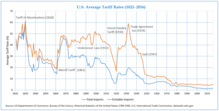
Average tariff rates in Us (1821–2016)
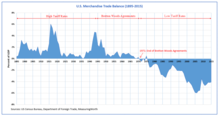
U.Due south. trade balance and merchandise policies (1895–2015)
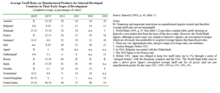
Average tariff rates on manufactured products

Boilerplate levels of duties (1875 and 1913)
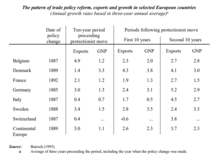
Merchandise policy, exports and growth in European countries
ISI is a development theory, but its political implementation and theoretical rationale are rooted in trade theory. It has been argued that all or virtually all nations that have industrialized have followed ISI. Import commutation was heavily practiced during the mid-20th century every bit a form of developmental theory that advocated increased productivity and economic gains within a country. It was an inward-looking economic theory practiced by developing nations afterward World War 2. Many economists and then considered the ISI approach as a remedy to mass poverty by bringing a developing country to a developed condition through national industrialization. Mass poverty is defined every bit "the dominance of agricultural and mineral activities – in the low-income countries, and in their inability, because of their structure, to profit from international trade" (Bruton 905).
Mercantilist economic theory and practices of the 16th, 17th, and 18th centuries frequently advocated building up domestic manufacturing and import substitution. In the early United States, the Hamiltonian economic programme, specifically the tertiary report and the magnum opus of Alexander Hamilton, the Report on Articles, advocated for the U.S. to go self-sufficient in manufactured goods. That formed the ground of the American Schoolhouse in economics, which was an influential force in the land during its 19th-century industrialization.
Werner Baer contends that all countries that have industrialized subsequently the U.k. take gone through a phase of ISI in which much investment in industry was directed to replace imports (Baer, pp. 95–96).[16] Going farther, in his book Kicking Away the Ladder, the Southward Korean economist Ha-Joon Chang also argues based on economic history that all major adult countries, including the United Kingdom, used interventionist economic policies to promote industrialization and protected national companies until they had reached a level of development in which they were able to compete in the global market. Those countries adopted free marketplace discourses directed at other countries to obtain two objectives: to open their markets to local products and to prevent them from adopting the same development strategies that had led to the industrialization of the adult countries.
Theoretical basis [edit]
As a fix of development policies, ISI policies are theoretically grounded on the Prebisch–Singer thesis, on the infant industry argument, and on Keynesian economics. The associated practices are normally:
- an active industrial policy to subsidize and orchestrate product of strategic substitutes
- protective barriers to trade (such as tariffs)
- an overvalued currency to help manufacturers import capital goods (heavy mechanism)
- discouragement of foreign direct investment
By placing loftier tariffs on imports and other protectionist, inward-looking trade policies, the citizens of any given country by using a simple supply-and-demand rationale substitute the less expensive good for a more expensive one. The primary industry of importance would gather its resources, such every bit labor from other industries in this situation. The industrial sector would use resources, capital, and labor from the agricultural sector. In fourth dimension, a developing state would look and behave similar to a developed country, and with a new accumulation of capital and an increase of total cistron productivity, the nation's industry would in principle be capable of trading internationally and of competing in the world market. Bishwanath Goldar, in his newspaper Import Substitution, Industrial Concentration and Productivity Growth in Indian Manufacturing, wrote: "Earlier studies on productivity for the industrial sector of developing countries accept indicated that increases in total cistron productivity, (TFP) are an important source of industrial growth" (Goldar 143). He continued that "a college growth rate in output, other things remaining the same, would enable the industry to attain a higher rate of technological progress (since more than investment would be made) and create a situation in which the constituent firms could take greater advantage of scale economies." It is believed that ISI will allow that (Goldar 148).
In many cases, however, the assertions did non apply. On several occasions, the Brazilian ISI process, which occurred from 1930 to the late 1980s, involved currency devaluations to boost exports and discouraging imports, thus promoting the consumption of locally-manufactured products, equally well equally the adoption of dissimilar commutation rates for importing capital goods and for importing consumer goods. Moreover, government policies toward investment were not e'er opposed to foreign capital: the Brazilian industrialization process was based on a tripod that involved governmental, private, and strange uppercase, the first existence directed to infrastructure and heavy industry, the second to manufacturing consumer goods, and the third to the production of durable goods such as automobiles. Volkswagen, Ford, GM, and Mercedes all established production facilities in Brazil in the 1950s and the 1960s.
The principal concept underlying ISI can thus be described as an try to reduce foreign dependency of a country'due south economy by the local production of industrialized products by national or foreign investment for domestic or foreign consumption. Import exchange does not mean eliminating imports. Indeed, every bit a state industrializes, information technology naturally imports new materials that its industries demand, often including petroleum, chemicals, and raw materials.
Local ownership import substituting [edit]
In 2006, Michael Shuman proposed local ownership import substituting (LOIS), as an alternative to neoliberalism. It rejects the credo that at that place is no alternative.[17] Shuman claims that LOIS businesses are long-term wealth generators, are less likely to exit destructively, and have college economic multipliers.[xviii]
Latin America [edit]
Import substitution policies were adopted past nigh nations in Latin America from the 1930s to the late 1980s. The initial date is largely attributed to the impact of the Keen Low of the 1930s, when Latin American countries, which exported chief products and imported almost all of the industrialized goods that they consumed, were prevented from importing considering of a sharp reject in their foreign sales, which served equally an incentive for the domestic production of the appurtenances that they needed.
The first steps in import substitution were less theoretical and more pragmatic choices on how to face up the limitations imposed by recession even though the governments in Argentina (Juan Domingo Perón) and Brazil (Getúlio Vargas) had the precedent of Fascist Italian republic (and, to some extent, the Soviet Union) equally inspirations of state-induced industrialization. Positivist thinking, which sought a strong government to modernize society, played a major influence on Latin American military thinking in the 20th century. The officials, many of whom rose to power, like Perón and Vargas, considered industrialization (especially steel product) to be synonymous with "progress" and naturally placed as a priority.
ISI gained a theoretical foundation only in the 1950s, when the Argentine economist and UNECLAC leader Raúl Prebisch was a visible proponent of the idea, likewise as the Brazilian economist Celso Furtado.
Prebisch had feel running his state'south central depository financial institution and started to question the model of export-led growth.[xix] Prebisch came to the decision that the participants in the free-trade regime had unequal power and that the fundamental economies (specially, United kingdom of great britain and northern ireland and the Us) that manufactured industrial goods could control the cost of their exports.[19] The unequal powers were taking the wealth from developing countries, leaving them with no fashion to prosper.[20] He believed that developing countries needed to create local vertical linkages and that they could not succeed except past creating industries that used the master products already existence produced domestically. Tariffs were designed to permit domestic infant industries to prosper. In doing then, Prebisch predicted many benefits: dependence on imports would lower, and the country would not be forced to sell agricultural appurtenances for depression prices to pay for industrial goods the income charge per unit would go up, and the country itself would take a strong growth.[xx]
ISI was most successful in countries with large populations and income levels, which immune for the consumption of locally-produced products. Latin American countries such as Argentina, Brazil, and United mexican states (and to a bottom extent Chile, Uruguay and Venezuela) had the most success with ISI.[21]
While the investment to produce cheap consumer products may be profitable in pocket-sized markets, the same cannot exist said for capital letter-intensive industries, such as automobiles and heavy machinery, which depend on larger markets to survive. Thus, smaller and poorer countries, such as Republic of ecuador, Honduras, and the Dominican Democracy, could implement ISI merely to a limited extent. Peru implemented ISI in 1961, and the policy lasted until the end of the decade in some class.[22]
To overcome the difficulties of implementing ISI in pocket-size economies, proponents of the economic policy, some within UNECLAC, suggested two alternatives to enlarge consumer markets: income redistribution within each state by agrarian reform and other initiatives aimed at bringing Latin America'south enormous marginalized population into the consumer marketplace and regional integration by initiatives such equally the Latin American Gratuitous Trade Association (ALALC), which would allow for the products of i country to be sold in another.
In Latin American countries in which ISI was well-nigh successful, information technology was accompanied past structural changes to the government. Old neocolonial governments were replaced by more-or-less democratic governments. Banks, utilities, and certain other foreign-owned companies were nationalized or had their ownership transferred to locals.
Many economists contend that ISI failed in Latin America and was one of many factors leading to the so-called lost decade of Latin American economics, only others[ who? ] contend that ISI led to the "Mexican miracle;" from 1940 to 1975, the annual economic growth stood at six% or higher.
As noted by one historian, ISI was successful in fostering a great bargain of social and economic development in Latin America:
"By the early 1960s, domestic manufacture supplied 95% of United mexican states's and 98% of Brazil's consumer appurtenances. Betwixt 1950 and 1980, Latin America'southward industrial output went upwards six times, keeping well alee of population growth. Baby mortality savage from 107 per 1,000 alive births in 1960 to 69 per 1,000 in 1980, [and] life expectancy rose from 52 to 64 years. In the mid-1950s, Latin America's economies were growing faster than those of the industrialized W."[23]
Africa [edit]
ISI policies were implemented in various forms beyond Africa from the early on 1960s to the mid-1970s to promote ethnic economic growth within newly-independent states. The national impetus for ISI can be seen from 1927, with the creation of the Eastward African and Central African common markets in British and French colonies that recognized the importance of common trading tariffs in specific parts of the continent and aimed to protect domestic manufacturing from external competitors.[24]
Colonial economies [edit]
Early on attempts at ISI were stifled by colonial neomercantilist policies of the 1940s and the 1950s that aimed to generate growth past exporting master products to the detriment of imports.[25] The promotion of exports to metropoles was the chief goal of the colonial economical system. The metropolitan governments aimed to offset colonial expenditures and accomplish primary commercial products from Africa at a significantly-reduced rate.[26] That was successful for British commercial interests in Ghana and Nigeria, which increased twenty times the value of foreign trade betwixt 1897 and 1960 considering of the promotion of export crops such equally cocoa and palm oil.[27] Such economical growth occurred at the expense of ethnic communities, which had no say over the crops that were produced and retained marginal profits from their agricultural output.[28] That model also expanded monocultures, whose economies were centered on a single crop or natural resource for exports. Monoculturing was prevalent in countries such as Senegal and Gambia, where groundnuts deemed for 85% to ninety% of earnings throughout the 1940s.[29] That economic model rendered the postcolonial states vulnerable to unstable export prices and failed to promote the diversification of the economic system. Postcolonial governments were too sceptical of the reliance on multinational corporations for economic development, as they were less probable to pay taxes and exported capital abroad.[thirty] Thus, ISI policies were adopted to redirect African economies towards indigenous growth and industrialisation.
Mail service-colonial economic situation [edit]
The underdeveloped political and economic structures inherited beyond post-colonial Africa created a domestic impetus for ISI. Marxist historians such as Walter Rodney contend that the gross underdevelopment in social services were a direct issue of colonial economic strategy, which had to be abandoned to generate sustainable development.[31] [32] Rene Dumont supported that ascertainment and argued that African states were administratively overburdened as a result of colonialism.[33] The initial, unchanged conditions created discontent in states such equally Ghana and Tanzania during the early 1960s over the fall in wages and employment opportunities. The unrest culminated in a series of mass strikes and tensions between governments and trade unions.[34] Dissatisfaction with the poor economical progress upon decolonisation made information technology clear to African leaders that they could no longer rely on rhetoric and tradition to maintain ability and could retain the support of their political base but through a coherent economic model aligned with their political interests. The culmination of the political and economical problems necessitated the adoption of ISI, every bit it rejected the colonial neo-mercantilist policies that they believed had led to underdevelopment.
Ideological foundation [edit]
For leaders of mail-colonial African nations, it was imperative for their economic policies to represent an ideological suspension with the imperialist models of evolution. To achieve that, some newly-independent states pursued African socialism to build indigenous growth and break costless from capitalist development patterns.[35] Through the adoption of African socialism, leaders such equally Kwame Nkrumah, Julius Nyerere, and Leopold Senghor hoped to establish a model of development based around consciencism an intellectual and cultural revolution; and, most chiefly, a big push in industrialization towards rapid development for the continent.[36] I of the primary aspects of the big push button towards evolution was the growth of parastatals from 1960 to 1980.[37] The country-owned trading corporations were given command over the import-export business as well every bit the retail-wholesale distribution.[38] That allowed mail-colonial states to nationalise industries and retain the profits from their output, rather than allow capital flying to the west through multinational corporations.
The growth of African socialism in the pursuit of ISI tin be seen in the 1967 Arusha Proclamation (Tanzania) in which Nyerere argued that "nosotros cannot go enough money and borrow enough technicians to beginning all the industries we demand and fifty-fifty if nosotros could go the necessary assist, dependence on it would interfere with our policy on socialism."[39] The need for indigenous development formed the cadre of the African socialist vision whereby the state would manage a planned economy to prevent it from beingness controlled by the free market, which was regarded every bit a grade of neo-imperialism.[xl] In line with that economic vision, Tanzania engaged in the nationalization of manufacture to create jobs and to produce a domestic market for appurtenances while information technology maintained an adherence to African socialist principles exemplified through the ujamaa plan of villagization.[41] The unaffordability of industrial products and increased tensions between managers and settlers of the villages contributed to a "colossal failure" of ISI in Tanzania, leading it to abandon the villagization projection and to focus on agricultural development.[42]
While ISI under African socialism was purported to be an anti-Western development model, scholars such as Anthony Smith argued that its ideological roots came from Rostow'due south modernization theory, which maintains that commitment to economical growth and costless-market capitalism is the most efficient means of state development.[43] Kenya's implementation of ISI under state capitalism exemplifies the model of evolution. Tom Mboya, the offset minister for economic development and planning, aimed to create a growth-oriented path of industrialization, even at the expense of traditional socialist morals.[44] Kenya's Sessional Paper No. 10 of 1965 reinforced the view by claiming, "If Africanization is undertaken at the expense of growth, our reward will exist a falling standard of living."[45] Under such a evolution path, multinational corporations occupied a ascendant function in the economic system, primarily in the manufacturing sectors.[46] Economic historians such as Ralph Austen argue that the openness to western enterprise and technical expertise led to a higher GNP in Kenya than comparative socialist countries such as Ghana and Tanzania.[47] However, the 1972 World Bank ILO report on Kenya claimed that direct state intervention was necessary to reduce the growing economic inequalities that had occurred every bit a result of land commercialism.[48]
Implementation [edit]
In all of the countries that adopted ISI, the state oversaw and managed its implementation, designing economical policies that directed evolution towards the indigenous population, with the aim of creating an industrialised economy. The 1972 Nigerian Enterprises Promotion Decree exemplified such control, as it required foreign companies to offering at to the lowest degree 40% of their equity shares to local people. A state-controlled economy has been criticized by scholars such as Douglas N who claim that the interests of political elites may exist self-serving, rather than for the skillful of the nation.[49] That correlates with the theory of neo-patrimonialism, which claims that post-colonial elites used the coercive powers of the state to maintain their political positions and to increase their personal wealth.[fifty] Ola Olson opposes that view by arguing that in a developing economy, the regime is the only player with the financial and political means to unify the country apparatus behind an industrialization process.[51]
Outcomes [edit]
Sub-Saharan Africa's experiment with ISI created largely-pessimistic results beyond the continent by the early on 1980s. Manufacturing, which formed the core of the big push towards industrialisation, accounted for only vii% of GDP across the continent by 1983.[52] The failures of the model stemmed from various external and domestic factors. Internally, efforts to industrialise came at the expense of the agricultural sector, which accounted for 70% of the region's workforce throughout the 1970s.[53] The neglect was detrimental to producers also as the urban population, as agricultural output could not meet the increasing demands for foodstuffs and raw materials in the growing urban areas. ISI efforts likewise suffered from a comparative disadvantage in skilled labor for industrial growth.[54]
A 1982 World Bank report stated, "There exists a chronic shortage of skills which pervades not simply the pocket-sized manufacturing sector but the entire economy and the over-loaded government machine."[55] Tanzania, for case, had just 2 engineers at the beginning of the import-substitution period.[56] The skills shortage was exacerbated by the technological deficiencies facing African states throughout industrialisation. Learning and adopting the technological resource and skills was a protracted and plush process, something that African states were unable to capitalise on because of the lack of domestic savings and poor literacy rates across the continent.[57] Externally, the oil shocks of the 1970s and the subsequent economical stagnation of the West reduced the power of oil exporter states such as Nigeria to balance their payments through oil product.[58] The global ramifications of the oil shocks too reduced the imports of uppercase and intermediate goods into African economies, every bit donor states increasingly became inwards-looking throughout an economically-tumultuous catamenia.
The failure of ISI to generate sufficient growth in industrialisation and overall development led to its abandonment by the early on 1980s. In response to the underdeveloped economies in the region, the IMF and the Globe Bank imposed a neo-classical counter-revolution in Africa through Structural Adjustment Programmes (SAPs) from 1981.[59] The new economic consensus blamed the low growth rates on excessive protectionism in the industrial sector, the fail of exports, and the depression agronomical productivity.[60] For the Imf and the Globe Bank, the solution to the failure of import substitution was a restructuring of the economic system towards strict adherence to a neoliberal model of development throughout the 1980s and the 1990s.
Russia [edit]
In recent years, the policy of import substitution by tariffs, the replacement of imported products by domestic products, has been considered a success because it has enabled Russia to increase its domestic production and to relieve several billion dollars. Russia has been able to reduce its imports and to launch an emerging and increasingly-successful domestic production in almost all industrial sectors. The most important results have been achieved in the agriculture and nutrient processing, automotive, chemical, pharmaceutical, aviation, and naval sectors.
In 2014, customs duties were applied on imported products in the nutrient sector. Russian federation has considerably reduced its nutrient imports, and domestic production has increased considerably. The cost of nutrient imports dropped from $60 billion in 2014 to $20 billion in 2017, and the state enjoys record cereal production. Russian federation has strengthened its position on the earth food marketplace and has go food cocky-sufficient. In the fisheries, fruit, and vegetables sectors, domestic production has increased sharply, imports take declined significantly, and the merchandise residuum (the deviation between exports and imports) has improved. In the second quarter of 2017, agricultural exports were expected to exceed imports, which would make Russia a net exporter for the first fourth dimension.[61] [62]
The policy of import substitution by tariffs has led many other industries to be adult. For example, in the aviation manufacture, Russia is developing a significant range of new aircraft. The aerospace industry is expected to reach an annual turnover of $50 billion by 2025. In 2017, the pharmaceutical industry represented $5 billion and will probably double in 2022, but in 2012, the country's medical industry was negligible. The country has ready itself the objective of producing 90% of the drugs deemed "vital" on its territory.[ citation needed ] In 2017, Russia spent only $vi billion on imported cars, but the value of imports reached $20 billion in 2007. The energy sector is besides booming, and the country has succeeded in developing its own technology and has continued to develop oil drilling and gas production centres.
Criticism [edit]
Import substitution policies might create jobs in the short run, but equally domestic producers replace foreign producers, both output and growth are lower than would otherwise take been in the long run.[ citation needed ] Import exchange denies the country the benefits to be gained from specialisation and foreign imports. The theory of comparative advantage shows how countries within the model gain from merchandise, however, this concept has received criticism for its misguided underlying assumptions and inapplicability to modernistic production. Moreover, protectionism leads to dynamic inefficiency, equally domestic producers have no incentive from foreign competitors to reduce costs or meliorate products. Import substitution can impede growth through poor allocation of resources, and its consequence on exchange rates harms exports.[63]
Results [edit]
Despite some apparent gains, import substitution was "both unsustainable over time and produced high economic and social costs."[64] Given import substitution's dependence upon its developed and isolated markets within Latin America, it relied upon the growth of a market that was limited in size. In most cases, the lack of experience in manufacturing and the lack of contest reduced innovation and efficiency, which restrained the quality of Latin American produced appurtenances, and protectionist policies kept prices high.[64] In addition, ability was concentrated in the hands of a few, which decreased the incentive for entrepreneurial development. Lastly, the big deficits and debts resulting from import substitution policies are largely credited for the Latin American crunch of the 1980s.[65]
Meet also [edit]
- The Commanding Heights for an exposition of the furnishings of ISI on Latin American economies
- International trade
- Export-oriented industrialization
- Local purchasing
- Mercantilism
- Prebisch–Singer thesis
- Protectionism
- Voluntary export restraints
- There is no alternative (TINA)
- Industrial policy
- Babe industry argument
References [edit]
- ^ A Comprehensive Lexicon of Economics p.88, ed. Nelson Brian 2009.
- ^ Mehmet, Ozay (1999). Westernizing the Third World: The Eurocentricity of Economic Development. London: Routledge.
- ^ Chang, Ha-Joon (2002). Kick Away the Ladder: Development Strategy in Historical Perspective. London: Anthem Press.
- ^ Street, James H.; James, Dilmus D. (1982). "Structuralism, and Dependency in Latin America." Journal of Economical Bug, 16(3) p. 673-689.
- ^ "History of ECLAC". Economic Committee for Latin America and the Caribbean. United Nations. 2014-ten-08. Retrieved ten Oct 2016.
- ^ Renato, Aguilar (1986). "Latin American structuralism and exogenous factors."Social Scientific discipline Information, 25(one) p. 227-290.
- ^ Arndt, H.W. (1985). "The Origins of Structuralism."World Development, xiii(2) p. 151-159.
- ^ Perreault, Thomas; Martin, Patricia (2005). "Geographies of neoliberalism in Latin America."Environment and Planning A, 37, p. 191-201.
- ^ Irwin, Douglas A. (2021). "The rise and fall important substitution". World Evolution. 139: 105306. doi:10.1016/j.worlddev.2020.105306. ISSN 0305-750X. S2CID 229472224.
- ^ Oatley, Thomas (2019). International Political Economy: Sixth Edition. Routledge. pp. 164–165. ISBN978-1-351-03464-seven.
- ^ a b c d Oatley, Thomas (2019). International Political Economy: Sixth Edition. Routledge. pp. 193–197. ISBN978-1-351-03464-vii.
- ^ Frieden, Jeffry A. (2018). "Affiliate 10". Earth Politics: Interests, Interactions, Institutions (4 ed.). Westward W NORTON. ISBN978-0-393-67510-8. OCLC 1197968459.
- ^ Rodrik, Dani; Grossman, Gene; Norman, Victor (1995). "Getting Interventions Right: How Southward Korea and Taiwan Grew Rich". Economical Policy. 10 (xx): 55–107. doi:10.2307/1344538. ISSN 0266-4658.
- ^ Perkins, Dwight H.; Tang, John P. (2017). O'Rourke, Kevin Hjortshøj; Williamson, Jeffrey Gale (eds.). East Asian Industrial Pioneers. The Spread of Modernistic Industry to the Periphery since 1871. Oxford University Press. doi:ten.1093/acprof:oso/9780198753643.001.0001. ISBN978-0-19-875364-3.
- ^ Oatley, Thomas (2019). International Political Economy: Sixth Edition. Routledge. pp. 180–181. ISBN978-one-351-03464-7.
- ^ Baer, Werner (1972), "Import Substitution and Industrialization in Latin America: Experiences and Interpretations", Latin American Research Review vol. seven (Bound): 95–122.(1972)
- ^ Shuman, M. H. (2006). The Modest-Mart Revolution: How Local Businesses are Beating the Global Competition. San Francisco, CA: Berrett-Koehler.
- ^ "Cage Friction match: TINA vs LOIS". treehugger.com . Retrieved 4 April 2018.
- ^ a b H., Chase, Michael (2015-06-26). The world transformed : 1945 to the present. p. 227. ISBN978-0-19-937102-0. OCLC 907585907.
- ^ a b Hunt, Michael (2014). The World Transformed. New York: Oxford University Press. pp. 227–228. ISBN978-0-xix-937102-0.
- ^ Blouet, Olwyn; Olwyn Blouet; Brian Westward. Blouet (2002). Latin America and the Caribbean: A Systematic and Regional Survey. New York: John Wiley.
- ^ "ECONOMIC HISTORY AND THE ECONOMY OF PERU". www.sjsu.edu . Retrieved 4 April 2018.
- ^ Globalization and the Postcolonial World: The New Political Economy of Development by Ankie Hoogevelt
- ^ A Mendes. M Bertella. R Teixeira (2014). ". 'Industrialization in Sub-Saharan Africa and Import commutation policy'". Brazilian Journal of Political Economy: 124.
- ^ Austen, Ralph (1987). African economic history : internal development and external dependency. J. Currey. p. 205. ISBN9780852550083.
- ^ Austen, Ralph (1987). African economical history : internal development and external dependency. J. Currey. pp. 206–215. ISBN9780852550083.
- ^ Austin, Gareth (1 March 2010). "African Economic Development and Colonial Legacies". Revue internationale de politique de développement. 1 (1): 21. doi:10.4000/poldev.78.
- ^ Dumont, Rene (1988). Simulated offset in Africa. Earthscan. pp. 31–33. ISBN1853830275.
- ^ Rodney, Walter (2012). How Europe underdeveloped Africa (Rev. ed.). Pambazuka. p. 234. ISBN978-1788731188.
- ^ Kennedy, Paul (1988). African commercialism : the struggle for ascendency . Cambridge Academy Press. p. 61. ISBN0521319668.
- ^ A Mendes. Chiliad Bertella. R Teixeira (2014). "Industrialization in Sub-Saharan Africa and Import substitution policy". Brazilian Journal of Political Economy: 126.
- ^ Rodney, Walter (2012). How Europe underdeveloped Africa (Rev. ed.). Pambazuka. p. 203–221.
- ^ Dumont, Rene (1988). False start in Africa. [2nd ed.] Earthscan. p. 79.
- ^ Lynn Krieger Mytelka (1989). ""The Unfulfilled Promise of African Industrialization". African Studies Review: 91.
- ^ Martin Meredith (2006). The State of Africa: A History of Fifty Years of Independence . Complimentary Press. p. 144. ISBN9780743232227.
- ^ Akyeampong (2018). "African socialism; or, the search for an indigenous model of economic development?". Economic History of Developing Regions: 73–77.
- ^ Paul Ove Pedersen, Dorothy McCormick (1999). "African Business Systems in a Globalising World". The Journal of Modernistic African Studies: 113.
- ^ Paul Kennedy (1988). African capitalism the struggle for ascendency . Cambridge University Press. p. 65.
- ^ Dennis Cohen. "Course and the Analysis of African Politics: Issues and Prospects". Political Economy of Africa: 189.
- ^ Kwame Nkrumah (1965). Neo-colonialism the Last Stage of Imperialism. Nelson. pp. 239–243.
- ^ A Mendes. M Bertella. R Teixeira (2014). "Industrialization in Sub-Saharan Africa and Import substitution policy". Brazilian Journal of Political Economy: 130.
- ^ IG. Shivji (2010). "The village in Mwalimu's idea and political practice". Africa's Liberation: The Legacy of Julius Nyerere: 121.
- ^ A.D. Smith (1973). The Concept of Social Change . Routledge. p. 33. ISBN9780710076076.
- ^ Daniel Speich (2009). "The Kenyan Mode of "African Socialism: Developmental Knowledge Claims and the Explanatory Limits of the Cold War". Diplomatic History: 457.
- ^ Republic of Republic of kenya (1965). African Socialism and Its Application to Planning in Republic of kenya. Republic of kenya. p. 18.
- ^ Ralph Austen (1987). African Economic History. Oxford Academy Publishing. p. 246.
- ^ ibid. p. 247.
- ^ Hans W. Singer and Richard Jolly (1972). Employment, Incomes and Equality: A strategy for Increasing Productive Employment in Kenya.
- ^ Douglas Due north (1985). Structure and Change in Economic History. North and Co.
- ^ Daniel C. Bach (2011). "Patrimonialism and neopatrimonialism: comparative trajectories and readings". Commonwealth & Comparative Politics: 281.
- ^ S. Wangwe (2014). "The functioning of the manufacturing sector in Tanzania: Challenges and the way forward". WIDER Working Paper No. 2014/085.: 31.
- ^ A Mendes. M Bertella. R Teixeira (2014). "Industrialization in Sub-Saharan Africa and Import substitution policy". Brazilian Periodical of Political Economy: 135.
- ^ Ernest Aryeetey, Nelipher Moyo (2012). "Industrialisation for Structural Transformation in Africa: Advisable Roles for the State"". Periodical of African Economies: 65.
- ^ R. Gulhati, U. Sekhar (1981). ""Industrial strategy for late starters: the experience of Kenya, Tanzania and Zambia". Staff Working Paper; No. SWP 457.
- ^ ibid. : 32. ;
- ^ Emmanuel Akyeampong (2018). "African socialism; or, the search for an ethnic model of economic development?"". Economic History of Developing Regions: 71.
- ^ A Mendes. M Bertella. R Teixeira (2014). "Industrialization in Sub-Saharan Africa and Import commutation policy". Brazilian Periodical of Political Economy: 133.
- ^ James Hamilton (1983). "Oil and the Macroeconomy since Globe War II". Periodical of Political Economy: 229.
- ^ Olu Ajakaiye, John Folio (2012). "Industrialisation and Economic Transformation in Africa: Introduction and Overview". Journal of African Economies: 10.
- ^ Earth Bank (1981). Accelerated evolution in sub-Saharan Africa: an agenda for activity (English). The World Bank.
- ^ Samofalova, Olga (ten Feb 2017). "Food import substitution turns out to exist extremely assisting". Retrieved 15 March 2018.
- ^ "Record breaking nutrient product in Russia could run across exports reaching $40 billion". Farming Independent.
- ^ Import Exchange and Industrialization in Latin America: Experiences and Interpretations. Baer, 1972
- ^ a b Franko, P. M. (2007). The puzzle of Latin American economical evolution (3rd ed.). Lanham: Rowman & Littlefield.
- ^ Jeffrey Sachs (1985), "External Debt and Macroeconomic Performance in Latin America and Due east Asia," Brookings Papers on Economical Action two, pp. 523–73.
Sources [edit]
- Jeffry A. Frieden: Global Capitalism.
Further reading [edit]
- Chasteen, John Charles. 2001. Built-in in Blood and Fire. pages 226–228.
- Reyna, José Luis & Weinert, Richard S. 1977. Authoritarianism in United mexican states. Philadelphia, Pennsylvania: Institute for the Written report of Human Issues, Inc. pages 067–107.
- UNDP Paper
- Bruton, Henry J. "A Reconsideration of Import Exchange." Journal of Economical Literature. 36.2 (1998): 903–936. Print.
- Bishwanath, Goldar. "IMPORT SUBSTITUTION, INDUSTRIAL CONCENTRATION AND PRODUCTIVITY GROWTH IN INDIAN MANUFACTURING* PRODUCTIVITY GROWTH IN INDIAN MANUFACTURING." Oxford message of Economic science and Statistics. 48.ii (1986): 143–164. Print.
External links [edit]
- TINA vs. LOIS: start selling internationally for a summary of the alternative from the Autumn 2007 issue of Sockeye Mag
- Muzzle Match: TINA vs LOIS
- BALLE's Homepage
- B Lab – the largest system providing benefit corporation certification
- Michael Shuman The current folio of the author of LOIS, with audio, video and his new book.
willisforgreforn91.blogspot.com
Source: https://en.wikipedia.org/wiki/Import_substitution_industrialization
0 Response to "what led india in the 1990s to abandon its system of import substitution?"
Post a Comment