Sections of Beef on a Cow
Have you always been confused by cuts of beef? If then, yous're not lonely. We're constantly receiving questions about beefiness cuts and how to cook each cut properly. Here are a few tricks to understanding beef cuts

Did you know that one of the many reasons beefiness cuts are bewildering is because of the naming convention of each cut. Grocery stores and butchers can cut beef in a variety of ways and proper name it however is best for their store or region (ahem…KC Strip and NY Strip). In fact, one study showed that many grocery stores carry more than 60 different beef products.
The expert news is that although beef cuts have so many different names, there are some easy tricks to agreement the different cuts.
Bound to:
- What are the unlike cuts of beef?
- Video: The secrets to understanding beef cuts
- Which cuts of beef are the almost tender? expensive?
- How to choose beef cuts:
- What the best beef cuts?
- What to wait for when buying beef at a grocery store:
- What beef cuts to get when purchasing farm fresh beefiness directly from a farm
What are the dissimilar cuts of beef?
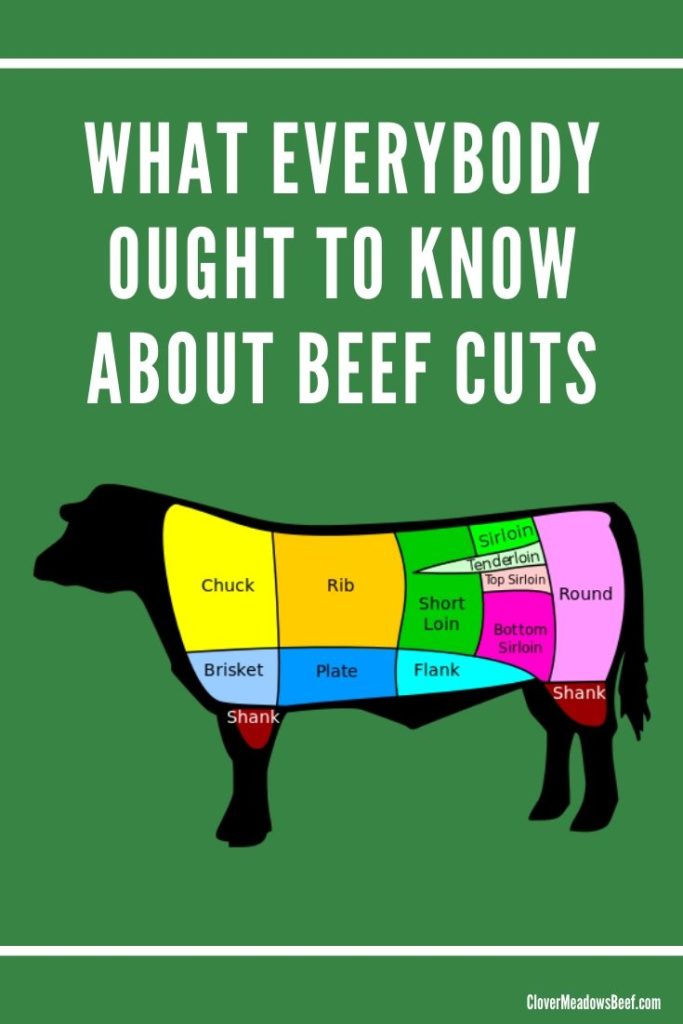
The USDA divides a moo-cow into 8 regions. They are called the primal cuts, or the main cuts.
These 8 are of import. You need to acquire them. If you practise, y'all tin easily understand everything you encounter at the grocery store. I promise.
Here are the eight fundamental cuts:
- Chuck
- Rib
- Loin (brusque loin and sirloin)
- Round
- Flank
- Short Plate
- Brisket
- Shank
Later on the primal cuts, beef gets divided into subprimal cuts — a cut of meat larger than a steak, roast or other single cut, but smaller than a side of beef. A butcher often times starts with a sub-primal cut, and they cut it into the individual sizes nosotros're used to seeing in the butcher case.
You buy and consume portion cuts. When you purchase from our farm, Clover Meadows Beef, you get individually wrapped, portion cutting steaks, roasts, ribs, and more.
Video: The secrets to understanding beefiness cuts
Which cuts of beef are the nearly tender? expensive?
Now that you lot accept the regions, all you lot need to call up is that the more expensive steaks are cutting from the center of the steer, which is the loin or rib department.
Why the middle? Because beef gets more than tender equally the distance from horn and hoof increases.
A steer'south legs and neck muscles do most of the work, so the muscles there are firmer. That makes these areas the toughest. The loin and ribs are at the heart of the animal, and compared to a neck muscle, they don't work much so they're tender cuts
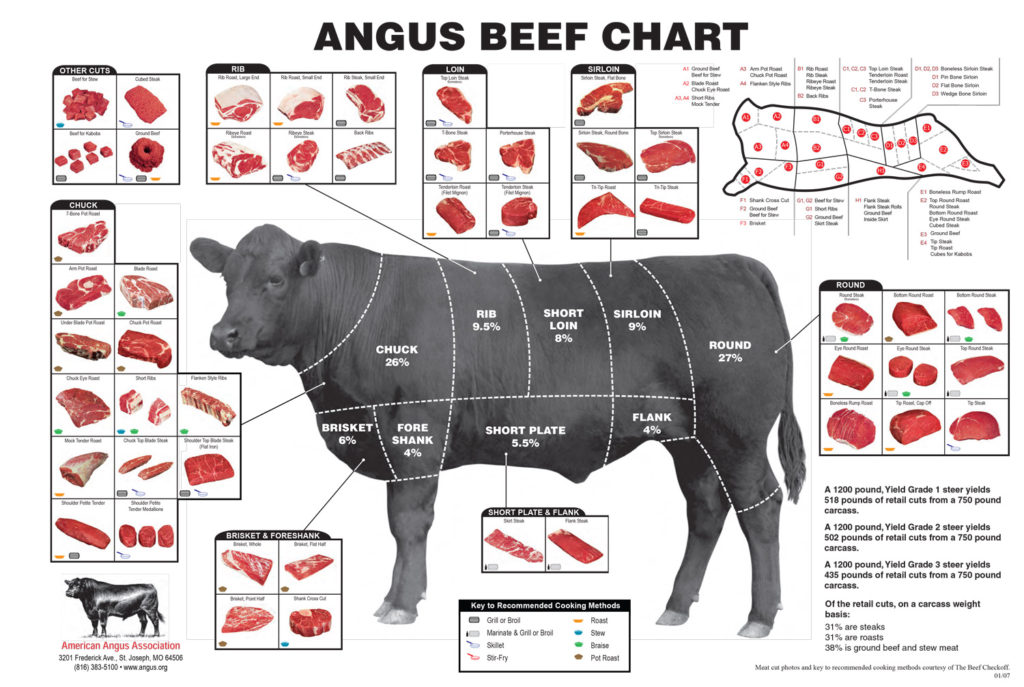
Have a 2d and look at the beef cut chart above. Really look at it. Did you discover the loin and rib section? They're at the very tiptop of the steer in the centre. The are the areas that are farthest away from the animal's caput and feet, which are the muscles that do almost of the work.
An case of the tender cuts in the loin and rib section are T-bone steak, strip steak, porterhouse, rib eye, rib steak and Filet Mignon. Is your rima oris watering yet? It should be! You may also be looking for your wallet considering you know these cuts are usually pricier.
How to cull beef cuts:
Since y'all probably don't want to carry effectually a beef cuts chart in your pocket, hither's what you need to know nigh each of the cuts:
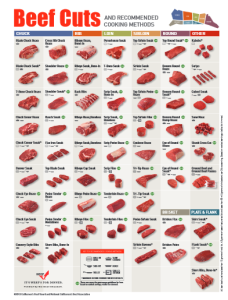
Chuck:
Chuck meat comes from the cow'south shoulder. Cows use their shoulder a lot, and then information technology's a tougher cut of beefiness. Notwithstanding, information technology'south likewise a very flavorful cut, and butchers cut it in a diverseness of ways so yous have lots of options at the grocery store.
Types of cuts you'll run across for chuck are ground chuck (hamburger), flat-atomic number 26 steak, chuck curt ribs, shoulder tender medallions, chuck pot roast, blade roast, boneless chuck brusk ribs, stew meat, country fashion ribs, and tiptop blade steak, just to name a few.
You should choose chuck beefiness when you want lots of flavor, only need to exist cost conscious besides.
Brisket:
The brisket is the steer's breast. Brisket is usually tough and contains a substantial amount of fat. But don't let that fool you! Chefs know that if y'all tenderize it with a marinade or rub, and melt information technology low and wearisome, it'll melt in your rima oris. Brisket is primarily used for charcoal-broil, corned beef or pastrami.
Cook a brisket when you want to cook low and slow.
Shank:
The shank is located at the animal'south forearm in front end of the brisket. Information technology is one of the toughest cuts. One of the nearly famous dishes that comes from the shank is Osso Buco, which requires braising to make the meat more tender. Make stews and soups with the shank.
Ribs:
The cow's ribs and backbone make upwards the ribs. At that place are thirteen pairs of ribs, but only the terminal section (vi-12) are in the primal section of the ribs. The others are in the chuck cut.
Ribs have lots of flavor and marbling. Types of cuts you'll run across for ribs are Delmonico steak, boneless ribeye roast, cowboy steak, ribeye steaks and beefiness short ribs.
Cull ribs when you want a tender cutting of beef with extra marbling.
Plate:
The plate, or short plate, is the other source of short ribs and it'due south institute near the belly. It is fattier. Brand fajitas, pastrami, brim steak, Philadelphia steak and curt ribs with this cut and y'all'll be happy with the results.
Loin:
The loin is where the almost expensive cuts of beef come from. It is located at the top of the steer directly behind the rib, and since it'southward not a heavily used muscle, it'due south very tender.
The loin has two parts: shortloin and sirloin.
Popular cuts from the shortloin are filet mignon, tenderloin steak, T-bone, Porterhouse steaks, strip steak, New York Strip, and KC Strip.
Earlier nosotros talked about how 1 cutting of beefiness oftentimes has several different names. The shortloin is a cracking example of this.
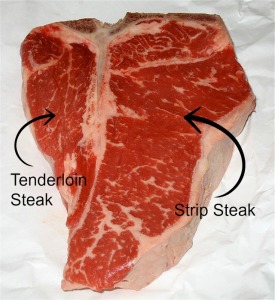
A T-Bone and Porterhouse are from the shortloin. They're the same steak. The merely minor difference is a Porterhouse is a larger version of the T-Bone.
Then, when you cut the beef out effectually the "T" bone, you get 2 unique cuts – a filet and a strip steak. A strip steak has lots of difference names too similar New York Strip, Kansas City Strip, and hotel steak, just to name a few.
The sirloin area is a little less tender than the shortloin, but information technology'due south as well more flavorful. Common cuts from the sirloin area are sirloin steak, center cutting sirloin steak, tiptop sirloin, bottom sirloin, ball tip steak, Tri-Tip Roast and Tri-Tip Steak.
Cook a cutting from the loin when you're hungry for a flavorful and tender cut of beef.
Circular:
The round is a lean and inexpensive cut. Information technology's found at the cow'southward rump and hind legs, so information technology's sometimes tough.
When you're at the grocery shop, you'll often see round sold as ground beefiness. Other mutual cuts are circular steak, eye of round, tip steak, tip roast, peak round and lesser round roasts.
Flank:
The flank is located below the loin. It has no bones, and is very flavorful just also very tough.
Information technology used to be less expensive at the grocery store, simply this has started to change. Why? Flank steaks are known for existence lean. Since consumers want lean meat more than ever before, it'due south increased flank steak's popularity and price.
Pop flank cuts are flank steak and London broil.
What the best beef cuts?
The loin department is where the most expensive and tender cuts are found, which makes it the best beef cut. Popular steaks from this expanse are the filet mignon, tenderloin steak, T-os, Porterhouse steaks, strip steak, New York Strip, and KC Strip.
The four almost popular cuts with steak aficionados and steakhouses are the tenderloin, ribeye, strip and T-os. These are all amazing cuts of beef, but choosing the "all-time" also comes down to personal preference and your taste buds, and we've written a lot well-nigh how to choose the best cut of steak.
What to look for when buying beef at a grocery shop:
If you're buying beefiness at a grocery store, here are a few pointers and then that yous're not staring at the beef case.
- Is it cold? Beef should be cold from the time it leaves the butcher until you buy information technology. If it's not cold to the touch, don't purchase it.
- What color is information technology? You want beefiness to be vivid red or purplish-reddish. Brown spots and other discolorations are bad. This likewise ways that it's important to choose beef that's in see-through packaging.
- What's the sell by date? This seems like an obvious 1, but brand sure you purchase beefiness earlier information technology'due south sell by engagement. Sometimes, beef volition continue auction when it's by it'due south sell-by date and if you purchase it, cook it sooner rather than later.
- Practice you come across moisture? When beef is fresher, there is less moisture in the package.
- Do y'all run across marbling? Marbling and fat are the white-ish colored lines y'all encounter in beef. You want it to exist consistent and even throughout the beef. For lean cuts like sirloin steak, you want less fat. For tender cuts like ribeye steak and chuck roast, marbling makes it more flavorful and is why the beefiness volition melt in your mouth.
- How is it graded? The USDA grades beef so that you know the tenderness and amount of marbling in the beef. Prime is the highest grade. Next is Choice and Select. Prime has more marbling and is more tender than Select, which is a lean cut of beefiness.
- What else is on the characterization? You've probably seen beef labeled with lean or extra lean on the label. To be lean, 100 grams of beef has to have less than 10 g of total fat, less than 4.5 m of saturated fat and less than 95 mg of cholesterol. Extra lean beef has less than 5 g of total fat, less than 2 g of saturated fat and less than 95 mg of cholesterol.
What beef cuts to get when purchasing farm fresh beef directly from a farm
The beefiness cuts you go when purchasing a side of beef from a farmer is a Large question, and we cover it fully in our post on how to buy a cow from a farmer.
1 of the biggest things to keep in mind is that a steer is not all steak. In fact, near of the beast is footing beef.
Let's say you decide to buy a one-fourth of a cow from our farm. With a quarter beef, you would get about 110 pounds of beef. Of this, 50 pounds would be ground beef, and the remaining sixty pounds would be steaks, roasts, brisket, etc.
It always suprises people that they can't have the entire animal cut every bit their favorite cutting. But remember, there are limits of each blazon of beef cut per animal. Back to our T-bone example in a higher place. If you're working with a butcher and choosing your beefiness cuts you can have EITHER t-os steaks OR filets and strips. You tin't have both since all of those cuts come from the same section of beef.
If you've decided to buy a quarter, half or whole beef, please visit our other posts on buying a moo-cow so you can larn more than about cut lists and questions to inquire before purchasing.
1 more affair!
Do y'all want to learn more virtually beef? Below are a few popular beef posts and recipes y'all may like. In addition, we have an entire ebook about beefiness that goes through purchasing and preparing beefiness from a farmers perspective.
- Buying a Cow. How Much Beef Is It?
- Is It Washed Yet? The Best Meat Thermometer
- Defrosting Meat: four Safety & Piece of cake Ways
- Slow Cooker Pepper Steak
- Prime Rib Roast with Garlic Herb Butter
Nosotros take a weekly e-newsletter where we share about farm happenings, when our side by side beef availability is, and all things beefiness. When you do, yous'll get a crook sheet with 9-must-ask questions before buying beef directly from a farmer.
Pin it for later!
We participate in the Amazon Services LLC Associates Program, an affiliate advertizing programme designed to provide a means for u.s. to earn fees by linking to Amazon.com and affiliated sites. Run into our disclosure policy for more details.
willisforgreforn91.blogspot.com
Source: https://www.clovermeadowsbeef.com/beef-cuts/
0 Response to "Sections of Beef on a Cow"
Post a Comment